

A digital marketing strategy framework connects a business outcome to audience decisions, a credible offer, useful discovery, conversion, lifecycle operations and measurement. For 2027, build those connections before choosing more channels or tools. SEO, AEO, GEO, paid media, CRO and automation should share facts, responsibilities and evidence rather than operate as isolated programmes.
This framework is a planning method, not a prediction that every business will use the same channels in 2027. Written in October 2026, it treats future platform behaviour as uncertain and makes review conditions part of the strategy. Start with what your business needs to achieve and what it can reliably deliver.
In this guide
- What does an integrated growth strategy need to define?
- Stage 1: How should goals and commercial definitions be agreed?
- Stage 2: How should audience and buying decisions be researched?
- Stage 3: How should the offer and evidence library be built?
- Stage 4: How should SEO AEO GEO strategy share the same foundation?
- Stage 5: What role should paid media play in the full-funnel marketing plan?
- Stage 6: How should CRO turn attention into a useful customer action?
- Stage 7: How should automation support lifecycle operations?
- Stage 8: What belongs in a marketing measurement framework?
- How should ownership connect the strategy framework’s stages?
- How can a 90-day implementation plan avoid premature expansion?
- How should the framework prepare for uncertain 2027 changes?
- What should the integrated strategy operating worksheet contain?
- Frequently asked questions about digital marketing strategy frameworks
What does an integrated growth strategy need to define?
Write a concise strategy brief with the business goal, priority audience, problem, offer, customer action, constraints and decision owner. Include the current evidence and the assumptions that still need testing.
The brief should explain choices. If the business prioritizes one audience, identify why it fits the offer and capacity. If a channel is excluded, state the reason. A strategy that includes every possible activity does not help the team allocate scarce resources.
Keep the brief usable across functions. Marketing needs the audience and message; product needs the claims and limitations; sales needs eligibility and the promised next step; finance needs commitments and review conditions. Integration begins with shared meaning rather than a dashboard combining unrelated numbers.
An effective brief might say: help a defined class of operations teams evaluate a scoped service, provide the evidence required for that evaluation and route eligible requests to an accountable specialist. The wording is less glamorous than “dominate the market,” but it gives the team a concrete customer task to support.
Stage 1: How should goals and commercial definitions be agreed?
Choose the outcome the business can influence and observe. Distinguish marketing activity, customer action and commercial result. Publishing an article is an activity; an eligible assessment request is an action; an accepted opportunity or customer outcome belongs to a later business stage.
Agree the stage definitions before launch. Define what makes an enquiry eligible, who accepts it and which conditions create an opportunity. Avoid allowing campaign reporting and sales reporting to use the same word for different records.
Document constraints: available budget, delivery capacity, sales coverage, expert review time and technical readiness. The plan must respect all of them. A business cannot solve a capacity problem solely by increasing acquisition investment.
Choose a review period suited to the work. A broken form can be verified after repair; a content programme or long buying cycle requires different evidence over time. Set leading and lagging measures without pretending every task should produce immediate revenue.
Stage 2: How should audience and buying decisions be researched?
Use actual questions from sales, support, interviews and available research. Identify the problem, alternatives, decision participants, evaluation criteria and reasons a prospect may be unsuitable. Keep the origin and date of important observations.
Separate evidence from hypotheses. A sales team may believe a particular objection is common; inspect available records or interviews before making it the centre of the strategy. A generated persona can suggest questions, but it does not establish real customer behaviour.
Map the decisions the customer must make. These may include recognizing a problem, comparing approaches, verifying compatibility, assessing the supplier and understanding implementation. The sequence can vary; use the map to identify useful resources rather than forcing every person through one rigid funnel.
Identify underserved questions. A service page may describe benefits while omitting prerequisites or exclusions. A campaign may emphasize speed while buyers need to understand implementation effort. Those gaps create specific work for content, website and sales teams.
Stage 3: How should the offer and evidence library be built?
Define the offer’s audience, scope, outcome, prerequisites and limitations. Explain what the customer receives and what happens next. Keep commercial promises aligned with the team’s actual delivery authority.
Create a claim library with the statement, evidence source, relevant product or service version, scope, owner and review trigger. Approved facts should be reusable across content, ads, service pages and sales material. Adapt the explanation to the format while preserving the underlying conditions.
Use examples carefully. A hypothetical scenario can explain a method when clearly labelled. A customer result requires appropriate evidence and approval. An illustration should not quietly become a testimonial or a guarantee through reuse.
Treat evidence maintenance as part of the strategy. Product changes, changed platform instructions and revised service boundaries can invalidate published claims. Assign an owner who can notify every affected channel when the source of truth changes.
Stage 4: How should SEO AEO GEO strategy share the same foundation?
SEO supports search discovery and the usefulness of the destination. AEO focuses attention on answering relevant questions clearly and accurately. GEO examines how brands and sources appear in generated responses. These perspectives can overlap, and a business should understand the actual work before creating separate budgets for each acronym.
Start with accessible, purposeful pages. Google’s description of Search distinguishes crawling, indexing and serving results and does not guarantee inclusion. Technical eligibility supports discovery; it does not establish that a page will appear for every desired question.
Map one clear page purpose to a customer decision. Use direct answers where useful, then explain conditions, evidence, alternatives and a next step. Avoid manufacturing many nearly identical pages for minor wording variations.
Maintain consistent entity and product information. Company identity, service names, capabilities and limitations should agree across relevant public sources. Where a citation or mention is observed in an AI answer, record the platform, date and question. Keep the observation separate from a referral visit or a commercial outcome.
Use structured information where it accurately describes visible content and fits the platform’s applicable requirements. Do not assume a special file, markup label or formatting trick guarantees selection in generated answers. The strategy should invest in the useful underlying explanation and verifiable facts.
Stage 5: What role should paid media play in the full-funnel marketing plan?
Give each campaign a defined audience, offer and destination. Paid media can distribute a useful resource or evaluation action, but it cannot make an unclear offer coherent. Readiness should include accurate creative, an appropriate landing page and a working follow-up process.
Define the meaningful action before selecting the optimization goal. A business might value eligible assessment requests rather than every button click. Check that the chosen measurement represents the intended action and that irrelevant or duplicated events do not dominate the signal.
Separate media allocation from management, creative, destination and measurement costs. Set change permissions and review conditions. A successful small experiment does not automatically establish that unlimited expansion will remain commercially useful.
Use audience and message observations to improve the broader plan. Questions raised through a campaign may reveal missing evaluation content; poor-fit requests may reveal an unclear offer or targeting issue. Keep a route for those findings to reach the responsible team rather than remaining inside an advertising report.
Stage 6: How should CRO turn attention into a useful customer action?
Conversion work should reduce avoidable barriers while preserving the information needed for a good decision. Review the promise, evidence, action, form, confirmation and handoff as one journey.
A page may attract relevant visitors yet leave them unsure about suitability. A form may collect useful fields but fail on mobile. A confirmation may promise a response the team cannot provide. Diagnose the actual barrier before deciding that the solution is more traffic or a shorter form.
Define a hypothesis for each improvement. For example, explaining service prerequisites may reduce unsuitable requests and improve the quality of accepted conversations. Track relevant outcomes rather than assuming that a higher raw completion rate is always better.
Validate public changes after release. Inspect the rendered page, complete the intended action and confirm the downstream record. Website development and conversion-rate optimization should work from the same journey and verification criteria.
Stage 7: How should automation support lifecycle operations?
Automate a defined process with a trigger, input requirements, decision rules, permitted actions and an exception path. An enquiry workflow needs more than an acknowledgement: it may need deduplication, eligibility checks, assignment and an accountable next step.
Maintain suppression and preference rules appropriate to the relationship. Do not assume every collected address belongs in every campaign. Make the audience conditions and responsible business owner explicit.
Use AI assistance within a bounded task. A model might draft a summary from supplied records or suggest categories for review. Define what it can access, what evidence it must preserve and which actions require approval. Generated content should not gain authority merely because it fits a required format.
Plan recovery. Missing fields, duplicate requests and unavailable services are normal operating conditions. Log failures, alert an owner and retain a usable manual route. Marketing automation should improve a process the business understands and can maintain.
Stage 8: What belongs in a marketing measurement framework?
Create a dictionary covering events, CRM stages, eligibility, costs and reporting periods. Assign the source system and owner for each field. A combined report is only useful when its inputs describe compatible concepts.
Google Analytics provides recommended events, including lead-related actions, with prescribed implementation context. Map the business’s actual actions to appropriate events and verify implementation; a familiar event name does not establish that it is recorded correctly.
Keep evidence levels separate:
| Evidence | What it describes | What it cannot establish alone |
|---|---|---|
| Activity | Work performed or distribution purchased | Customer value |
| Visibility | Search appearance, mention or citation | A visit or sale |
| Interaction | A recorded visit or content action | Commercial eligibility |
| Enquiry | A request received | Accepted opportunity quality |
| Commercial progress | A defined sales or customer stage | Marketing causality |
Document attribution models and gaps. An association or assigned credit does not prove that an interaction caused the outcome. Expose unmatched records and missing inputs rather than forcing a complete-looking narrative.
Connect reporting with decisions: continue, expand, redesign, pause or retire. Data analytics should make the evidence understandable, with its practical limits visible.
How should ownership connect the strategy framework’s stages?
Create a responsibility map. The commercial owner approves the offer and goals; the subject expert validates facts; the channel lead manages distribution; the website owner validates destinations; the lifecycle owner manages routing; the analyst checks measurement; and the budget owner approves investment changes.
One person may hold several roles in a small business. What matters is that each responsibility exists and the team knows how a decision moves between them. External specialists should have a clear brief and a route to the internal owner who can provide business context.
Use one shared backlog for cross-channel dependencies. A form defect found through paid media should reach the website owner. A changed product claim should reach content and campaign teams. A reporting mismatch should reach the source-system owner. This turns integration into everyday operating work.
How can a 90-day implementation plan avoid premature expansion?
Use the first phase to agree the goal, audience, offer and stage definitions. Inspect priority journeys and identify blocking issues. Collect the facts required for the initial content and campaign scope.
Use the second phase to deliver the foundation: priority pages, necessary measurement, the enquiry handoff and a bounded content programme. Validate the public journey and records before releasing dependent distribution.
Use the third phase to operate a manageable test, inspect customer questions and downstream quality, and review spending. Decide what to continue, change or defer. The phases describe a sequencing example, not a promise that every implementation fits the same calendar.
At each review, check readiness as well as outcomes. If the expert review queue is stalled or sales capacity has changed, revise the plan. More investment should be conditional on the business’s ability to deliver and evaluate the next stage.
How should the framework prepare for uncertain 2027 changes?
Separate durable operating needs from platform-specific hypotheses. Accurate offers, reliable journeys, clear ownership and useful evidence remain sensible investments. A new reporting interface or discovery feature may require a bounded update once its documentation and availability are confirmed.
Maintain a watchlist with the change, affected workstream, current source, uncertainty and review date. Do not redesign the entire strategy around an unverified prediction. Run a limited test when a change creates a relevant opportunity and the business can evaluate it.
Retire complexity that no longer serves a decision. An unused tool, duplicative workflow or stale report adds maintenance cost even if it once seemed innovative. A strategy should explain what the business stops doing as its evidence improves.
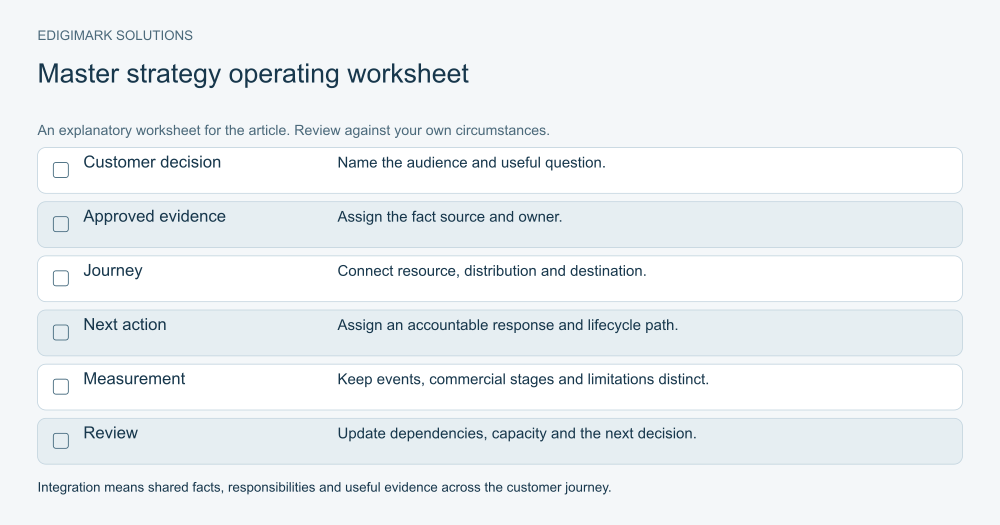
What should the integrated strategy operating worksheet contain?
Use one row per customer decision or journey need. Record the audience, question, approved evidence, destination, distribution route, next action, responsible owner and measurement definition. Add dependencies and the date of the next review.
For a hypothetical integration evaluation, the question might concern supported systems and implementation prerequisites. The approved resource explains scope; relevant search content and campaigns lead to that resource; an assessment request reaches a named owner; and the measurement distinguishes visits, requests and accepted evaluations. Each component has a job in the same customer journey.
The worksheet also reveals gaps. If a campaign has no suitable destination, the required work belongs in the backlog. If a page makes an unsupported claim, the fact owner must resolve it. If a request has no accountable next step, distribution should not be expanded as if the journey were ready.
Use the worksheet during reviews and handovers rather than treating it as a launch document that becomes stale. Update the source facts, ownership and dependencies when the business changes. The framework remains useful when it reflects the actual operating model and guides the team’s next decision.
Frequently asked questions about digital marketing strategy frameworks
Does every business need SEO, AEO, GEO and PPC together?
No. Choose work that supports your audience and customer journey. These perspectives can overlap, but each investment should have a clear purpose, feasible scope and way to evaluate evidence.
Is a framework the same as a channel calendar?
The framework explains goals, choices, responsibilities and measurement. A calendar schedules the resulting work. Scheduling posts without those decisions does not create a complete strategy.
Where should a small business start?
Begin with one clear audience, a credible offer and a reliable route to the next customer action. Address blocking foundation issues and choose a manageable set of activities before expanding.
How should AI fit into the framework?
Use it for defined tasks with appropriate inputs, evidence and review. Evaluate the complete workflow, including correction and maintenance, rather than assuming faster generation creates a better commercial outcome.
When should the strategy be revised?
Review it when the offer, capacity, audience evidence or operating environment changes. Regular reviews help, but changes should be tied to a documented reason and a revised decision.
How can Edigimark help apply the framework?
Edigimark can connect digital marketing strategy, CRM integration and the supporting website, analytics and automation work. Discuss your goals and current setup to define a practical integrated plan.
Put the ideas to work
Explore our connected growth services →