AI search visibility metrics should distinguish whether your brand was mentioned, whether a source linked to your website, whether someone visited and whether that visit supported a meaningful business outcome. A useful GEO dashboard preserves those differences, documents its sampling method and connects observations to relevant inquiries or customer actions where the data allows.
Counting mentions is easy. Understanding their value is harder. A mention in an irrelevant answer does little for a business. A citation to the wrong page can expose outdated information. A small number of qualified visits may be more useful than a large set of sampled appearances with no evidence of customer fit.
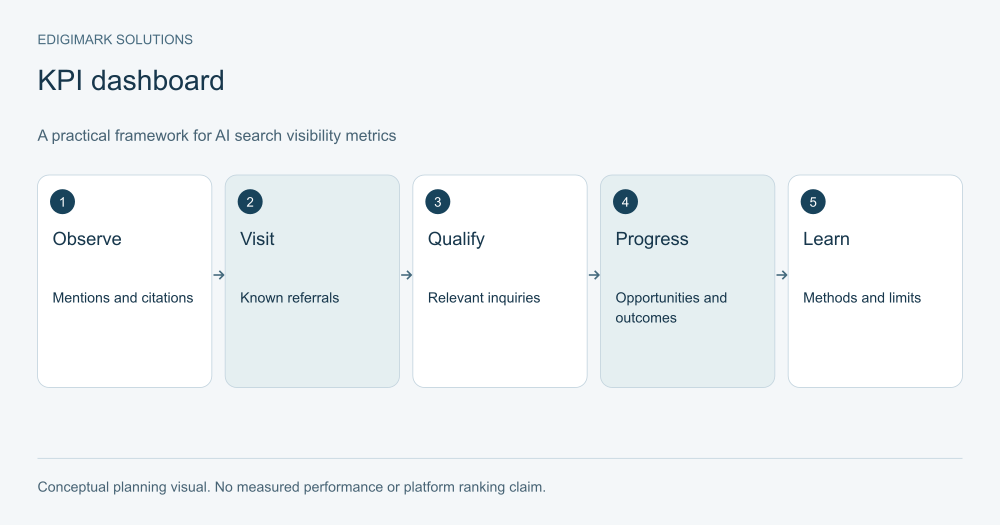
Conceptual framework for AI search visibility metrics; examples are illustrative.
Which AI search visibility metrics and AI search KPIs matter?
Begin with a business question. Are buyers discovering the company while researching a problem? Are useful resources being cited? Are visitors reaching the right service information? Are the inquiries suitable for the offer? Each question needs a different measure.
Arrange the dashboard in stages: observed exposure, source usage, website behavior and commercial progression. Do not present these stages as a fully tracked funnel unless the records actually connect them. A sampled answer and a later lead may be separate observations.
The dashboard should help the team make decisions. If it cannot tell you which page to improve, which claim to correct or which audience to investigate, more charts will not make it useful. Choose a small set of metrics with explicit definitions before expanding the reporting system.
How do you define a brand mention for AI share of voice?
A brand mention is an appearance of the company or product name in an observed answer. Record the correct identity and the context. A similarly named organization should not count. Neither should a prompt that explicitly instructs the assistant to mention you if your goal is to assess unaided discovery.
Classify relevance. Does the answer concern a problem you genuinely address? Does it describe the business accurately? Is the mention part of a recommendation, a comparison, a warning or a general list? A single total loses information about whether the exposure is useful.
Keep brand accuracy as a separate field. A mention that states the wrong service coverage can be a reason to review public information. It should not be celebrated simply because the name appeared. Visibility with a misleading description can create poor-fit inquiries and customer confusion.
How should AI citation tracking work?
A citation is a linked source included in an observed answer. Record the source URL, final destination, page type and the part of the answer it supports. A homepage link and a link to a technical guide serve different roles.
Check whether the destination contains the evidence implied by the answer. A citation does not necessarily endorse the company, and it does not prove the page influenced every part of the response. Preserve the answer and link so a reviewer can inspect their relationship.
Group citations by the public canonical resource where appropriate, while retaining the originally observed URL. This lets you see which maintained pages are being used without losing evidence about redirects or unexpected duplicates. Do not silently overwrite records and make the raw observation impossible to recover.
What is a defensible AI share of voice calculation?
Choose a fixed, documented question set relevant to your audience. Define the platforms, markets, language and observation schedule. Then define the denominator. For example, mention share within your selected competitor set is different from the proportion of sampled answers that mention your brand.
One possible calculation is: relevant sampled answers containing your brand divided by all eligible answers in the defined sample. Label it “sample mention rate” rather than implying a market-wide share. Another measure can count citations to your domain within a selected citation set, again with an explicit denominator.
Keep unanswered or failed queries visible. Excluding them without disclosure can inflate the apparent success rate. If a platform cannot be tested during a period, report coverage as missing. A precise percentage built from a changing sample is difficult to interpret.
How do you build a prompt sample for AI citation tracking?
Select questions from real buyer decisions, not just generic category names. Include problem discovery, evaluation, implementation and constraints. Keep branded and unbranded questions separate because they answer different research questions.
Record the full prompt and the conditions. Platform, date, language, location assumptions, account state and previous conversation can affect the observation. You may not control all of them, but you should record what you know. Retain screenshots or exports according to your data policy.
Do not rewrite the sample each month to include only questions that make the brand look good. Maintain a stable core set and a separately labeled exploratory set. The core supports comparisons; the exploratory set helps identify emerging customer concerns.
Manual observations can be appropriate for a small business. A tool can make repeated collection easier, but assess its coverage, storage method and limitations before trusting a score. Ask whether you can inspect the raw answers and whether the claimed metric represents a sample or a broader population.
What first-party Google reporting informs AI search visibility metrics?
Google now documents a Generative AI performance report for Search with impressions for supported features. Review its current definitions and availability in your property. Do not reuse older blanket advice that all AI visibility is inseparable from ordinary reporting.
The report’s scope is narrower than “all AI search.” It is not a cross-platform lead attribution system. Use its impression data alongside other approved reporting, keeping the source and date attached to each export. Compare like periods and dimensions rather than adding differently aggregated totals.
If the report is absent or has little data, record that condition. Missing visibility in a report can have several explanations, including access, coverage and eligibility. It is not by itself proof of a content quality problem. Check the relevant property and documented limitations before making a large strategy change.
How do you measure AI referral traffic alongside AI referral conversions?
Inspect available source information in your analytics and distinguish known assistant referrals from other visits. Maintain a documented channel definition. Some applications or privacy conditions may not preserve the information you want, so reported referrals can be an incomplete view.
Follow the landing pages and subsequent actions of identifiable visits. Did users read an implementation guide, inspect a service page, submit an inquiry or return later? Match the action to the page’s purpose. A support article should not be judged only by sales form submissions.
Keep the raw source alongside the normalized channel. If your classification rules change, you need to know which records were affected. This is a practical reason to involve data analytics before a dashboard becomes a permanent reporting dependency.
How should AI referral conversions be defined?
Define the conversion event before comparing channels. A completed contact form, a booked meeting, a qualified opportunity and closed revenue are different outcomes. Report them separately so the team can see where fit or follow-up breaks down.
Connect inquiries with CRM records using approved identifiers and privacy-aware processes. Record qualification criteria such as service fit, buying role, geography where relevant and timing. Avoid passing unnecessary personal data into content or AI monitoring tools.
For a hypothetical service business, ten form submissions may include students, existing customers and unsuitable requests. The meaningful count for acquisition could be the submissions that sales accepts under a documented definition. The numbers in that example are illustrative, not a forecast or Edigimark result.
An attribution label describes what the chosen model assigns. It does not prove sole causation. A person may encounter a brand through several sources before inquiring. Use CRM integration to improve record continuity, while stating the limits of what can be reconstructed.
How should AI search KPIs report assisted influence without overstating it?
Use clearly named evidence categories. Analytics may show an identifiable referral before a conversion. A customer may report that an assistant introduced the company. Sales may note that a comparison article helped a discussion. These observations can support interpretation, but they are not interchangeable measurements.
Do not count the full value of one opportunity under several channels and add the totals as if they were separate revenue. An assisted view can overlap a primary attribution view. Show the overlap or label the report as non-additive.
Qualitative feedback is useful when collected consistently. Ask a neutral discovery question rather than suggesting the answer you want. Record when the question was asked and whether the customer could name a source. “I used AI” is less specific than “I opened your migration guide from an answer.”
What should an AI search visibility metrics dashboard contain?
Use a compact table with the metric, definition, source, period, coverage and decision it supports. Include an owner and a data-quality note. For mention rate, show sample size. For referrals, show the channel rule. For opportunities, show qualification and maturity.
Add a page view that connects observed citations with the resource they link to. This can reveal outdated pages or a mismatch between the article being cited and the service users need next. Pair it with an action list so the dashboard leads to work.
Include a change log. A content release, website migration, new monitoring platform or changed prompt sample can affect the series. Without those notes, a trend line can tell a persuasive but incorrect story. The dashboard should make uncertainty visible instead of hiding it in a footnote.
What does a worked example of AI search KPIs look like?
Imagine a hypothetical B2B company maintaining a core set of questions about integration planning. It records observed mentions and citations monthly, while analytics tracks identifiable referrals. Sales records whether inquiries fit the implementation service.
The team notices that a frequently cited guide links to a vague service page. It improves that page’s scope and next step. During the next review period, it compares relevant visitor behavior and qualification, while noting a concurrent campaign that may influence demand.
The report can say what was observed: which answers linked to the guide, which identifiable visits arrived and how accepted inquiries changed. It should not say that the guide caused all new pipeline unless the study can establish that conclusion. This distinction preserves credibility while still giving the team useful direction.
The next action could be to clarify a prerequisite question, improve mobile navigation or test a lower-friction inquiry path through conversion rate optimization. Measurement becomes valuable when it guides a specific improvement.
How do you prevent AI share of voice metric gaming?
Keep the question sample and counting rules visible to stakeholders. Do not let a vendor change the denominator without disclosure. Require raw examples for reported gains and separate branded prompts from unaided discovery.
Use outcome checks to balance visibility counts. If mentions rise while accuracy or lead fit falls, the program needs investigation. An increase in a monitored score should not automatically trigger a larger publishing budget.
Avoid assigning a target before understanding baseline coverage. A small, unstable sample may require a better collection method rather than an aggressive percentage goal. The initial objective can be reliable reporting and a maintained improvement backlog.
How do you create an AI citation tracking measurement specification?
Write one specification for each metric before automating it. Include the name, definition, eligible population, source, collection schedule, exclusions, owner and known limitations. This may fit in a short table, but the choices should be explicit. A metric called “AI conversions” needs considerably more definition than its label suggests.
For a sample mention rate, specify which responses are eligible and whether repeated runs count separately. For citation tracking, define whether several links to one domain count once or several times. For referral outcomes, define the attribution window and whether returning visitors remain in the same analysis. These decisions change the result and should not be hidden inside a script.
Add a rule for changes. If you switch tools or revise the prompt set, preserve a break in the series or an overlapping comparison period where feasible. Do not draw a continuous trend line across incompatible definitions. The report should make a methodological change visible rather than imply a sudden market shift.
Keep a versioned dictionary with the dashboard. This allows a new analyst or external partner to understand how the numbers were produced. It also helps managers evaluate whether a proposed target is meaningful. A target is only useful when everyone agrees on what counts.
What should a monthly review of AI search KPIs decide?
Start by checking coverage and data quality, then review changes in relevant exposure and website behavior. Inspect a few raw answers and cited pages rather than relying entirely on aggregates. Look for inaccurate descriptions, outdated destinations or a mismatch between the audience and offer.
Next, review qualified outcomes with sales. Ask whether inquiries fit the service and whether the pages helped the conversation. If a source is unknown, keep it unknown rather than assigning it to the most fashionable channel. If feedback suggests assistant influence, record the evidence in its own category.
End with a short action list. One action might correct a product fact, another might improve a comparison page and a third might refine channel classification. Give each an owner and review date. The next meeting should inspect whether the action changed the underlying issue, not merely whether the ticket was closed.
Avoid reacting to a single unstable observation. A changed answer can prompt investigation, but it should not automatically trigger a wholesale rewrite. Look for patterns, business relevance and errors you can substantiate. This makes the measurement process practical for a team with limited time.
Finally, preserve the distinction between monitoring and research. Monitoring checks a stable question set; exploratory research asks new questions. Both can be useful, but they should not share a denominator without explanation. Clear separation lets you discover new opportunities while retaining an interpretable performance history.
Frequently asked questions
What is the most important GEO metric?
There is no universal single metric. Choose measures that support your business question. Qualified outcomes matter commercially, while mentions and citations help diagnose discovery. Keep their relationship explicit instead of collapsing them into one score.
Can we measure every AI-influenced lead?
Usually not with complete certainty. Source information can be missing, and buyers may use several interfaces. Report identifiable activity and consistently collected feedback, then state what remains unobserved or inferred.
How often should we collect AI search KPIs?
Choose a schedule that your team can maintain and your sample can support. A stable recurring review is more useful than frequent collection with shifting rules. Record major changes separately so comparisons remain interpretable.
Should we compare ourselves with every competitor?
Use a defined, relevant comparison set. Explain why each company belongs and keep it stable for the core report. A changing competitor list alters the denominator and can make apparent share gains meaningless.
Are tool visibility scores reliable?
They can be useful if the method, sample and limitations are clear. Ask for raw observations and definitions. A proprietary score should not be treated as a platform’s internal ranking metric or a guaranteed predictor of leads.
Build a dashboard that changes a decision
Define the business question, measurement method and next action before choosing more tools. Edigimark’s digital marketing services can connect search work with content and commercial reporting. Contact the team with your current data sources and qualification process to scope a useful measurement plan.
Put the ideas to work
Explore our connected growth services →