Does SEO still matter? Yes. Businesses still need useful, discoverable websites that explain their offers, earn trust and help customers act. AI search changes some discovery experiences, but it does not remove the need for accurate pages, technical reliability or relevant information. The strongest case for SEO is its contribution to those assets and to qualified demand, rather than a promise that every keyword will keep producing the same traffic.
The better question is which parts of your search work deserve investment now. A company with a confusing service page and an unreliable inquiry form has different priorities from a mature publisher assessing changes in informational visits. Treating both situations as “SEO is dead” prevents a useful diagnosis.
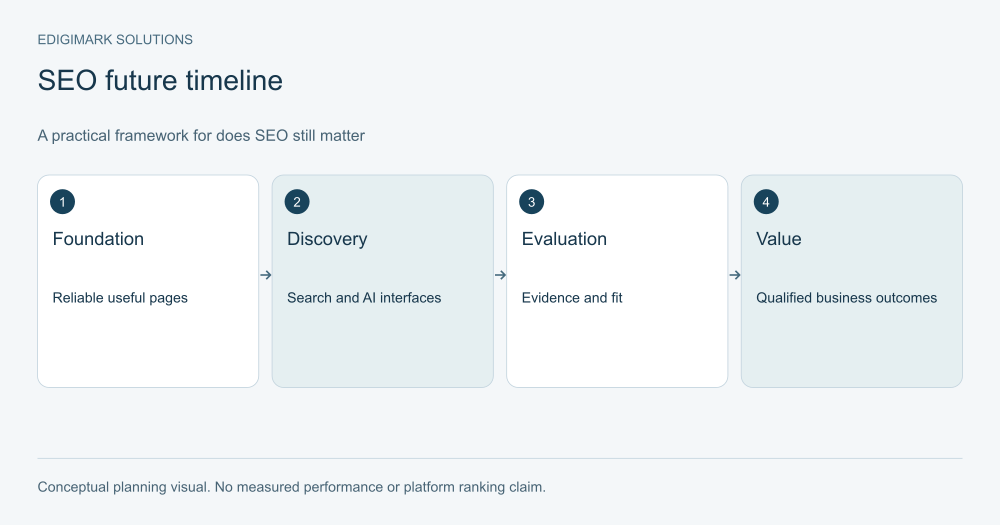
Conceptual framework for does SEO still matter; examples are illustrative.
Why is the future of SEO a business question?
SEO consumes time, expertise and budget. Its value should be assessed against your goals and constraints. A business may need qualified inquiries, product adoption, local appointments or fewer repeated customer questions. Traffic can support those outcomes, but it is not interchangeable with them.
Start by listing which customer needs your website serves. Where do people learn what you do? Where can they confirm compatibility or service scope? Where can they compare alternatives? Which pages answer a concern that otherwise delays a sale? These are information assets as well as acquisition assets.
A search program that improves those pages can create utility beyond one channel. Sales can share them, customers can find them directly and campaigns can use them as destinations. That broader usefulness does not excuse poor organic performance, but it should be part of an honest investment decision.
What does current evidence say about AI search and SEO?
Google explicitly keeps SEO relevant to its generative search features in its current optimization guide. That is a platform statement, not a guarantee that any individual site will gain visibility. Use it to reject the idea that basic website quality has suddenly become irrelevant.
Also separate platform documentation from forecasts. A vendor’s chart may reflect its monitored customers, a particular market or one class of queries. Before applying it to your business, ask about sample size, dates, interfaces and definitions. A measured decline in a publisher category does not automatically describe a service firm’s pipeline.
For 2027 planning, state assumptions openly. You can plan for more answer-oriented discovery and changing measurement without claiming to know exactly how people will behave next year. A resilient plan can adapt when evidence changes.
Which work preserves organic search value when interfaces change?
Clear descriptions of real services remain useful. Accurate product specifications remain useful. Technical delivery that makes a page accessible on mobile remains useful. Contextual navigation that helps a visitor find a relevant resource remains useful.
These are durable investments because they serve a customer task. A comparison page is valuable when it helps someone understand tradeoffs; an implementation guide is valuable when it prevents a poor decision. The same page can become a source for a search result, a campaign destination or a sales follow-up.
Prioritize work with more than one route to usefulness. If an article exists only to capture a broad term with no connection to your audience or offer, reassess it. If a high-intent page has outdated scope, broken links or vague proof, fixing it is a sensible starting point.
What parts of SEO in the AI era need rethinking?
The assumption that a higher traffic total necessarily means better marketing needs rethinking. Some visits are irrelevant, some are too early to produce an immediate inquiry and some arrive to accomplish an existing-customer task. A single aggregate total conceals these differences.
Content production based on keyword variations also needs scrutiny. A library of nearly identical pages creates an editing burden and makes it difficult to explain which page owns an answer. Invest in distinct resources whose purpose can be stated in a sentence.
Reporting needs to account for an imperfect view of discovery. A buyer might encounter a company in an assistant and later arrive through branded search. You should not attribute every branded visit to AI exposure, but you should recognize that a last-click report cannot establish every influence.
How do you assess organic search value today?
Divide the portfolio into commercial, informational and customer-support roles. Commercial pages need to make the offer and next action clear. Informational pages should attract a relevant audience and connect to an appropriate next resource. Support content should help users complete tasks and reduce confusion.
For each group, choose metrics that fit the role. Commercial pages may be assessed through qualified inquiry rates and opportunities. Informational pages may need topic relevance, engaged visits and assisted paths. Support pages may require successful task completion or feedback rather than lead generation.
Connect available analytics with business records through data analytics and, where appropriate, CRM integration. Define how an inquiry becomes qualified. Otherwise, an SEO report can celebrate a form increase that sales experiences as lower-quality demand.
When might SEO in the AI era be a lower immediate priority?
A new business without a clear offer may need positioning and customer conversations before expanding its content library. A company with a short deadline for a launch may need other channels to create immediate exposure. A product with little existing search demand may need education and distribution alongside search work.
Those situations do not mean SEO has no role. They change sequencing. Establish accurate core pages and technical reliability, then invest in content as evidence and demand become clearer. Avoid asking a search program to compensate for an undefined product or a sales process that cannot handle inquiries.
Opportunity cost matters. Compare the next SEO investment with other practical options using your own constraints. How much specialist time does it require? What dependencies exist? When can you evaluate it? A thoughtful decision can choose a smaller search program without declaring the channel obsolete.
How can you distinguish an AI search and SEO problem from a website problem?
Imagine a hypothetical B2B company whose organic visits are steady but inquiries have declined. Possible explanations include a changed audience mix, broken forms, unclear scope, new competition or a mismatch between the page and offer. Blaming AI search before checking these issues would skip the evidence.
Review representative sessions and the actual inquiry journey. Test forms on different devices. Compare the queries and landing pages behind the traffic. Ask sales which leads stopped fitting. Look for a date that aligns with a website release or offer change.
If visits fell on a broad educational page but qualified opportunities stayed stable, the commercial implication differs from a decline on a core service page. Report the specific loss and affected task. Good diagnosis prevents an oversized response to the wrong problem.
What should you keep, change and stop in SEO in the AI era?
Keep the practices that create clear, reliable information and usable pages. Change briefs that focus exclusively on keyword repetition into briefs that name a customer decision and evidence. Stop publishing assets whose only distinction is a slight wording change.
Keep a maintenance backlog for valuable existing content. Change reports that treat every visit or lead as equal. Stop accepting universal claims such as a fixed ideal word count or a guaranteed ranking deadline.
The exact list will differ by business. Review one cluster at a time and document the reason for each decision. A page can be merged, improved, retired or retained. Keeping everything because it was expensive to produce is not a strategy, and deleting everything because an aggregate chart fell is not a diagnosis.
How would an investment plan for the future of SEO look?
Start with the commercially important pages and their technical delivery. Give those pages clear service boundaries, proof the company can substantiate and an appropriate next action. Use conversion rate optimization to examine friction rather than assuming more traffic is the only solution.
Next, choose a small set of customer questions that support those offers. Assign evidence owners and review dates. Improve the connection between educational resources and relevant services, while keeping the articles useful for readers who are not ready to buy.
Finally, reserve a measured experimentation budget. Test new answer-oriented content formats or monitoring methods with defined questions and limitations. Keep the majority of effort attached to assets you can maintain and evaluate. A tool should answer a reporting need, not become the strategy itself.
What should leaders ask an SEO partner about organic search value?
Ask which customer tasks the proposed work will improve, why those tasks matter commercially and what existing data supports prioritization. Request examples of the evidence needed for an article and the checks that confirm metadata reaches the public website.
Ask how the partner distinguishes observed results from assumptions. What will be reviewed if a page attracts irrelevant visits? What happens when a product fact changes? Who owns access to analytics and content? These questions expose the operating process behind a polished proposal.
Avoid treating a tool score as the final answer. A checklist can catch omissions, but it cannot establish whether the page solves the right problem. The partner should be able to defend editorial decisions in plain language.
How do you build an investment case for organic search value?
Use a page-level problem statement. For a hypothetical consulting business, the issue might be that its service page attracts suitable visitors but fails to explain the deliverables. The proposed work is then to clarify scope, show the process and address qualification criteria. That is a more assessable investment than “improve authority.”
List costs in the same terms you use for other work: research time, specialist review, writing, design, development and maintenance. Include dependencies such as analytics access or approval to publish examples. A proposal that counts only writing hours will underestimate the work needed to create a reliable resource.
Define a realistic outcome hierarchy. The first outcome may be a complete, functioning page. The second may be better engagement from a relevant audience. The third may be qualified inquiries. Revenue is a later business outcome influenced by sales, pricing and fit. These stages make progress visible without guaranteeing a financial result.
Compare the proposal with an alternative use of the same resources. Would improving a campaign destination, training sales or repairing onboarding remove a larger current constraint? Search work can be a strong choice, but the team should be able to explain why this particular task comes first.
What does a page review for SEO in the AI era include?
Assess each page’s purpose, evidence, audience and relationship to the offer. Keep a page when it is accurate and still serves a distinct task. Improve it when the task remains useful but the content, delivery or next step is weak. Consider merging or retiring it when another page already answers the same question more effectively.
Do not judge by traffic alone. A narrow technical resource can receive few visits but help a valuable buying decision. A broad article can receive many visits from people outside your target audience. Look for the kind of usefulness the page is supposed to provide before deciding its fate.
When consolidating pages, identify which URL should remain and which information must be preserved. Check links and planned redirects with the website owner. A rushed cleanup can remove a resource customers still use or send them to a destination that no longer answers their question.
Document the reason for each decision so the next team does not recreate the same page. Include the source of the judgment: customer feedback, query relevance, outdated product facts or duplication. A decision log is more useful than a spreadsheet containing only red and green cells.
How do you set boundaries for an AI search and SEO experiment?
Choose one question the experiment should answer. For example: does a clearer service comparison attract more relevant inquiries? That question is narrower than asking whether SEO works for the entire business. It also suggests what to change and what to measure.
Keep a record of the original page, the revisions and other activity in the same period. A concurrent campaign or new sales offer can change performance. Your report can still describe the results, but it should not claim the page edit was the sole cause without a stronger design.
Use a review window suited to the decision cycle. If customers evaluate a service over several months, an early report can inspect inquiry quality while acknowledging that opportunity outcomes are immature. Avoid comparing recent leads with older cohorts that have had more time to progress.
Set a learning threshold as well as a success threshold. You may learn that visitors need a cost-component explanation before they will inquire. That can be a useful result even if the initial page change does not increase submissions. The next iteration should follow the evidence rather than add more keywords by default.
Finally, decide how much uncertainty the business can afford. A limited experiment is appropriate when the upside is plausible and the maintenance burden is small. A major content expansion deserves stronger evidence about audience need and delivery capacity. This is how a durable SEO plan remains accountable while the search environment evolves.
How do you keep organic search value decisions accountable?
Agree on a review cadence and a small decision log. Record the work selected, its intended user benefit, the evidence available and the outcome measures. At the next review, compare what was delivered with what was learned. A program can complete its tasks yet fail to resolve the chosen information gap; those are separate assessments.
Give the team permission to revise a hypothesis. If a page attracts the wrong audience, inspect its positioning and distribution. If qualified visitors understand the offer but hesitate to inquire, investigate the next step. Adding more articles should not be the automatic response to every disappointing metric.
Keep ownership of important assets clear. The business should retain access to its content, analytics definitions, website accounts and evidence records. This makes future evaluations possible when staff or partners change. A durable search program should leave a company with understandable resources and reliable records, not a dependency on unexplained scores.
The useful question at each review is whether the next investment removes a meaningful constraint. That question remains answerable even while interfaces and discovery habits evolve.
Frequently asked questions
Does SEO still matter for small businesses?
Yes, when customers need to discover or evaluate the business online. The appropriate scope may be a reliable website, clear local information and a few useful service resources. A small company does not need an enormous publishing schedule to begin.
Should we stop writing informational content?
Review its purpose before deciding. Content that answers relevant pre-purchase questions or supports customer success can remain valuable. Broad articles disconnected from your offer deserve a more critical assessment.
Is an AI mention proof that our SEO strategy works?
It is one observation. Record the conditions and relevance, then look for visits or other business evidence where available. A mention without a source link or meaningful context should not be counted as a completed customer journey.
Can SEO guarantee a steady stream of leads?
No. Demand, competition, implementation quality, audience fit and the sales experience all affect outcomes. A useful plan explains assumptions and measures progress without guaranteeing rankings or a fixed lead quantity.
How should we prepare for 2027?
Maintain useful core pages, improve evidence and establish better measurement. Review new platform documentation as it appears. Treat forecasts as hypotheses and preserve the ability to adjust the plan when your own data contradicts them.
Make the investment decision with your own evidence
SEO still matters when it helps the right people understand and choose your business. The scope should follow your goals, information gaps and resources. Edigimark’s digital marketing services can support that assessment; use the contact page to discuss your current pages, qualified demand and next priorities.
Put the ideas to work
Explore our connected growth services →