SEO for startups begins with proving that a specific audience searches for a problem your product can solve. Build a small set of useful, technically accessible pages around that demand, connect them to a credible offer, and use early enquiries and product behaviour to refine the plan. A startup SEO roadmap should create evidence for the next investment rather than assume that publishing at scale will produce customers.
The pressure to grow can make SEO feel like a volume exercise: more keywords, more landing pages, more articles. For a young company, the harder question is usually whether the traffic belongs to a market you can serve. A page can rank and still be a poor use of a small team’s time.
What should SEO for startups validate in an early-stage keyword strategy?
Write down the problem, the likely buyer, the product’s current capabilities and the next commercial milestone. Be specific about what exists today. A product roadmap can inform research, but a landing page should not advertise an integration or service as available when it is still a plan.
Talk to people who fit the intended audience. Ask how they describe the problem, what they currently use, what triggered their search and what would prevent them from changing. Save the language they use without turning every comment into an assumed keyword opportunity.
For a hypothetical software startup replacing a manual approval process, customers may search for the task rather than the software category. “Purchase approval spreadsheet” and “how to prevent duplicate purchase requests” could reveal a different entry point from the founder’s preferred category label.
SEO is a sensible candidate when relevant search behaviour exists and the startup can produce a useful destination. If the market is unfamiliar with the problem or the category, search may play a smaller role initially. Customer education, partnerships or direct outreach can help validate the audience while the SEO foundation develops.
How should an early-stage keyword strategy be built?
Start with problems, alternatives and evaluation questions. These three groups cover why someone looks, what they compare and what they need before choosing. Record the query, intended reader, proposed page, product relevance and available evidence.
An early-stage keyword strategy should distinguish established demand from uncertain language. A phrase suggested by a tool may not have the same meaning in your market. Inspect current results and speak to prospects before committing a major page to it.
Separate commercial pages from editorial pages. If someone searches for a tool or service, they may need capabilities, pricing context, implementation requirements and a clear action. If someone searches how to complete a task, a practical explanation may be the better destination.
Choose a limited initial set that the team can maintain. There is no universal number of pages a startup must launch. The correct set is large enough to test relevant demand and small enough to give each page a clear purpose and an accountable owner.
Avoid building a plan from competitor keywords alone. Established companies may target audiences your product does not serve, or benefit from a reputation you have not yet earned. Use competitors to understand the market, then prioritise the questions where your own product and knowledge provide a credible contribution.
What should SEO for startups fix before content production?
Check whether important pages load reliably, return the intended status, can be reached through navigation and present their core information without requiring a user login. Verify that production pages are not accidentally blocked or marked noindex after a staging launch.
Give each important page a descriptive title, a clear main heading and a stable URL. Where multiple URLs show substantially the same content, decide which version should be preferred and align the canonical, internal links and sitemap with that decision. A canonical tag does not repair a broken route or make a low-quality page useful.
Register and verify the appropriate Search Console property so the team can inspect discovery and indexing. Search visibility is not guaranteed: Google’s Search Essentials describes eligibility requirements rather than a promise that every submitted page will be indexed or ranked.
Test the commercial route from the page to the form, account creation or checkout. A startup can spend weeks writing articles while its main form silently fails. Someone should receive a test enquiry, confirm its source data where available and verify that the promised response process actually exists.
Coordinate these tasks with web development rather than treating technical SEO and product delivery as separate concerns.
Which pages should a startup SEO roadmap launch first?
Usually, the product or service explanation comes before a broad blog programme. A visitor needs to understand what is offered, who it suits, how it works and how to proceed. A homepage that says only “Transform your future” gives neither a prospect nor a search engine enough context.
Add the most relevant use-case pages where the use cases are genuinely different. Explain the workflow, prerequisites, limitations and expected implementation responsibilities. If two proposed pages would contain almost identical material, consider one stronger page with clear sections.
Then add a small set of supporting resources. An alternative comparison can help a buyer understand trade-offs. A setup guide can demonstrate practical knowledge. A diagnostic worksheet can help someone recognise whether their problem fits the product.
Do not invent customer proof to fill an empty case-study section. Explain the product accurately, show an actual demonstration if one is available, and label worked examples as hypothetical. A transparent illustration is useful; a fictional customer story presented as evidence undermines trust.
Every launch page should have a maintenance trigger. If a capability changes, the relevant page needs a review. That is easier when product, sales and marketing share a page inventory instead of relying on one person’s memory.
How should lean SEO prioritization weigh a popular topic against a specific buyer question?
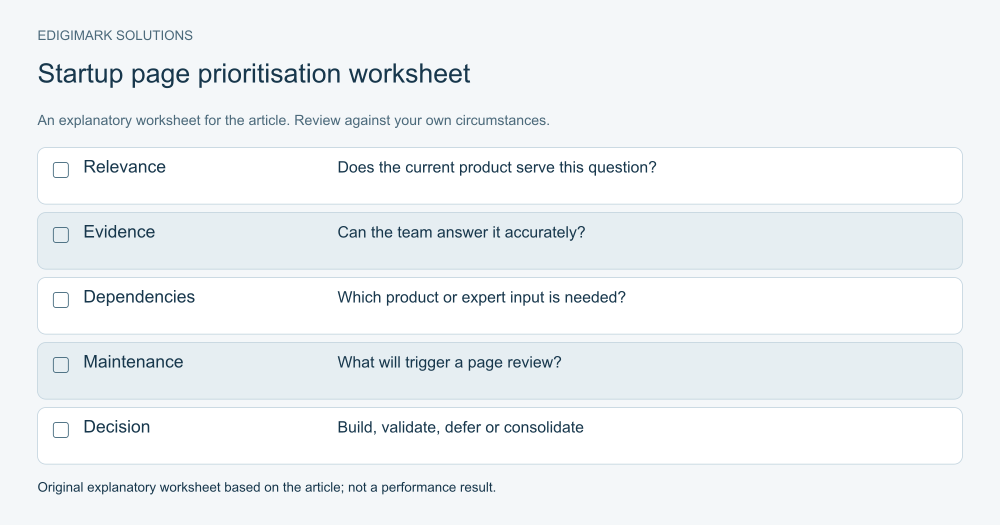
Use a simple prioritisation discussion rather than a false precision score. Consider product relevance, confidence in the audience, strength of the answer, effort required and the next decision the page can support.
A popular “what is automation” article may be difficult to differentiate and weakly connected to the product. A smaller “approval workflow for distributed purchasing teams” page might allow the startup to explain a concrete process and offer an appropriate demo. That does not prove the smaller topic will perform better; it gives a clearer reason to test it.
Lean SEO prioritization also considers dependencies. A comparison page may require legal or product review. A tutorial may need a working sandbox. A technical landing page may require engineering input. Include those constraints in the publishing schedule instead of declaring every topic equally ready.
Where confidence is low, reduce the commitment. Publish a focused answer, gather feedback and expand it when real questions justify the work. The aim is not to keep pages thin; it is to avoid creating a large inventory of speculative content before the startup understands the audience.
How can SEO for startups develop useful evidence?
Founders and product teams often have practical material hidden in everyday work: onboarding explanations, implementation choices, support answers, test procedures and reasons customers reject alternatives. Turn that knowledge into clear resources without exposing confidential information.
For example, a startup offering scheduling software could explain how it handles overlapping availability, what data a user must provide and what happens when a booking is cancelled. Those details are more useful than unsupported claims that the product revolutionises scheduling.
Original research can be valuable when the method is sound. Define the question, explain the sample and disclose limitations. A small customer survey should not be presented as representative of an entire industry. A product experiment should distinguish controlled observations from assumptions about business impact.
Attribution matters too. Link to the primary documentation for technical facts and clearly identify any inference you draw from it. Google’s guidance on helpful content encourages material that provides value beyond simply rewriting other sources. For a startup, product-specific explanation is often the most available route to that value.
How should startup organic growth connect to product learning?
Track what happens after the visit. A page that attracts relevant people but produces no account activation may reveal an unclear offer, an unsuitable trial or an onboarding problem. It may also attract a different audience from the one the team expected.
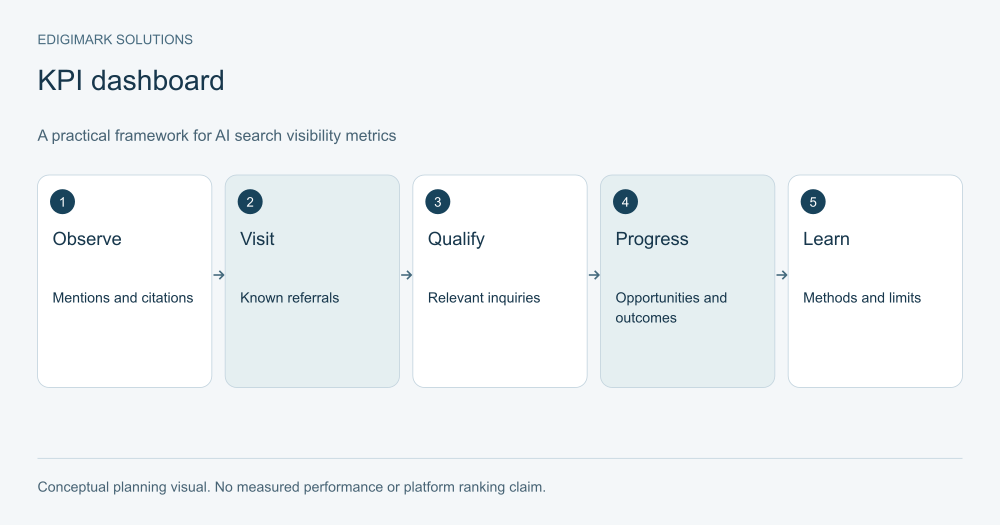
Set up a small measurement chain: relevant search visibility, qualified visits, meaningful enquiries or signups, activation and commercial outcomes where observable. Define each term before using it in a dashboard. A signup is not the same as an active user, and an active user is not automatically a paying customer.
Combine analytics with direct feedback. Ask new users what they were trying to accomplish and which information helped them decide. Sales and support notes can reveal concerns that are invisible in session metrics.
Keep attribution modest. Search can introduce a prospect who returns through another route, while a brand search can reflect interest created elsewhere. Use observed source data and self-reported information together without claiming that either captures the full journey.
Our data analytics service can help organise that measurement, but the startup must still agree on what meaningful product adoption looks like.
What does a realistic startup SEO roadmap look like?
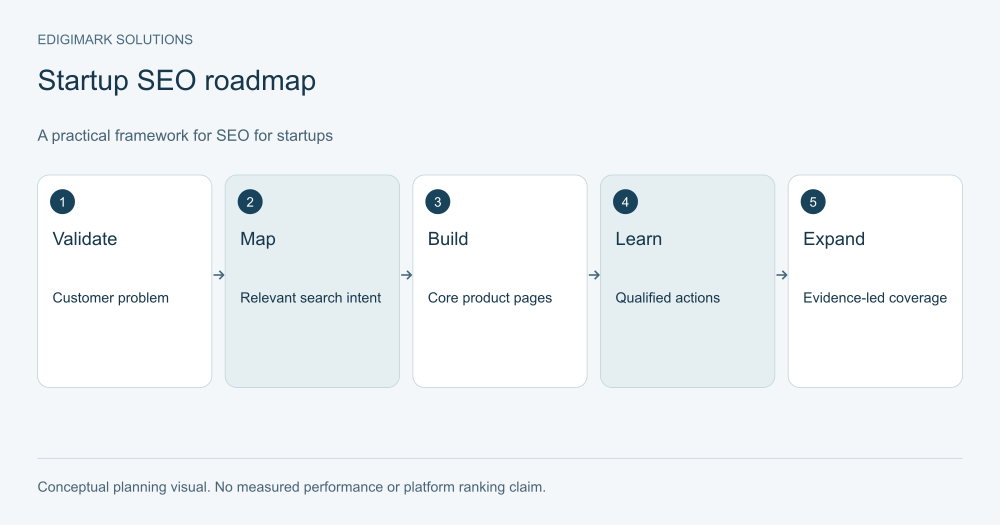
Organise the work into evidence gates rather than promises about ranking dates. The first gate is readiness: the website functions, the offer is accurate and the team can measure a meaningful action. The second is relevance: early visitors and enquiries fit the intended audience. The third is repeatability: additional pages can be produced and maintained with the same level of care.
At the readiness stage, audit the main pages, repair blockers and publish the core commercial explanation. At the relevance stage, add selected problem and evaluation resources, review search queries and collect buyer feedback. At the repeatability stage, expand the topics that show a credible connection to the business.
Schedule periodic reviews around the product release cycle. A rapidly changing startup may need to revisit pages sooner than an established service company. A roadmap that assumes content stays accurate for a year can quickly become a maintenance problem.
SEO can require sustained work, and the time to useful outcomes varies with the market, site and content. Keep the wider acquisition plan diversified so the business does not depend on a forecasted ranking that has not happened.
What should lean SEO prioritization rule out early?
Avoid buying a large content package before the audience and page strategy are clear. Avoid complex automation before the lead process works manually. Avoid a reporting stack that cannot answer a basic question about which enquiries are relevant.
Be careful with programmatic page generation. A startup may have useful structured data, but publishing hundreds of pages requires distinctive value, technical quality and a plan to keep the information accurate. Automatically combining a keyword with a city or industry name is not a substitute for knowing that audience.
Do not purchase links or use artificial engagement to create the appearance of credibility. Invest in resources, partnerships and product experiences that people have a legitimate reason to discuss or reference.
Spend selectively on expertise where the internal team has a material gap. A focused technical review or content workshop can be more useful than an open-ended production retainer before the strategic questions are settled. Digital marketing support should fit the company’s stage and constraints.
How can a founder keep a startup SEO roadmap manageable?
Assign one person to the page inventory and one clear decision-maker for product accuracy. Keep a short backlog with the reason each page matters. Record what is ready, what needs evidence and what is waiting for a product capability.
Use briefs that contain the reader’s question, the decision to support, the required evidence and the next action. Those details make external writing help more productive and reduce the chance of receiving generic articles that could belong to any company.
At each review, decide whether to improve, expand, consolidate or leave a page alone. Do not rewrite a useful page merely because traffic fluctuated for a week. Look at query relevance, technical status, product changes and the time needed for meaningful data.
Startup SEO becomes manageable when it is treated as a sequence of learning decisions. Talk with Edigimark about a focused starting plan if you need to identify the pages and measurements that belong in the first stage.
What belongs in a lean SEO prioritization decision log?
Keep a short record of the assumptions behind each priority. For a proposed comparison page, write the audience, the alternative being evaluated, the evidence that people make that comparison, and the product differences you can substantiate. Record what would make the page inappropriate, such as a capability that is not yet available.
After publication, add observations rather than rewriting the original assumptions. Did the search queries match the intended problem? Did enquiries mention the comparison? Did users reach an appropriate next step? A decision log makes it easier to learn from a page even when the traffic is modest.
Include the cost of maintaining the answer. A guide tied to fast-changing external software may require regular reviews. A resource explaining a stable operational principle may need less attention. A startup with limited technical capacity should account for that difference before choosing a large documentation programme.
Finally, define the next decision date and the evidence needed at that review. The team might need enough relevant visits to inspect behaviour, several sales conversations to validate the language, or a product release before it can broaden the page. A deadline to review the decision is useful; a promise that the keyword must rank by that date is not.
The log can be a simple shared document. Its value is that the founder, product team and marketer can see why work was chosen, what remains uncertain and what has changed since the original brief.
Frequently asked questions
Can a startup begin SEO before product-market fit?
Yes, but the purpose should include learning. Use search research and a small page set to test language, problems and audience relevance. Keep claims aligned with the current product. Avoid committing to a large content inventory around assumptions the team has not yet validated.
Should a startup target only low-competition keywords?
No. A keyword must also be relevant to the product and useful to the intended buyer. Low competition can reflect low commercial value or an unusual meaning. Inspect the results, validate demand where reliable data is available and assess whether you can provide a credible answer.
Is a blog necessary for startup SEO?
A blog is one publishing format, not a requirement for every opportunity. Product pages, use-case explanations, documentation and comparison resources may be more important initially. Add editorial content when it supports real audience questions and has a sensible connection to the offer.
How should a startup measure early progress?
Look at technical readiness, relevant search impressions, qualified visits and meaningful enquiries or product actions. Closed revenue may take longer to observe. Use these early indicators to decide what to investigate, while avoiding the claim that visibility alone proves a successful acquisition channel.
When should a startup expand its content programme?
Expand when the team has evidence of audience relevance, an accurate product story and a reliable production and maintenance process. Growth can also be justified by clear customer questions the initial site does not answer. More pages should increase useful coverage rather than duplicate existing explanations.