Answer engine optimization is the practice of making useful information easier to discover, understand and use when people ask questions through search, assistants and conversational interfaces. A practical AEO strategy starts with a real customer question, answers it directly, explains the conditions behind the answer and connects readers with evidence and an appropriate next step.
The goal is a better answer for someone making a decision. Appearing in an answer interface is a possible outcome, never a promise. For a business, the work is valuable when it removes uncertainty: what a service includes, whether a product fits a workflow, how implementation happens or why one approach costs more than another.
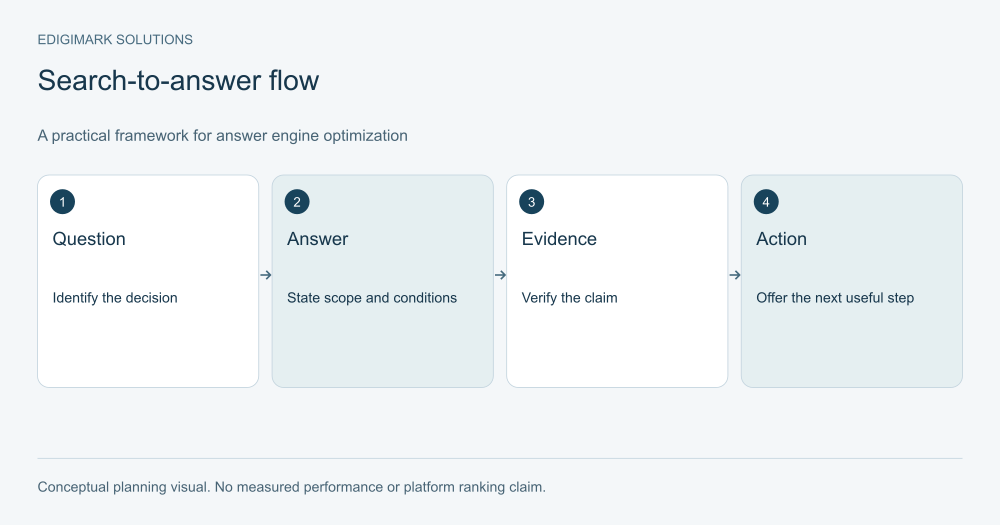
Conceptual framework for answer engine optimization; examples are illustrative.
What does answer engine optimization change in your content?
A conventional article can take several paragraphs to arrive at its point. That can work for an essay, but it is frustrating when the reader has a precise question. Direct answer content gives the conclusion early, then uses the rest of the page to make it credible and useful.
Consider a hypothetical software vendor answering whether a customer can migrate existing records. A weak introduction discusses the importance of digital transformation. A useful answer says which record types can be imported, which formats are accepted, what needs cleaning and when custom migration support is required. It then explains the process rather than pretending every migration is simple.
This approach helps people scan the page and lets a sales representative send a relevant section instead of recreating the explanation in email. Those practical benefits exist even if an AI service never quotes the page. They are a sounder reason to invest than an unsupported promise of inclusion.
How does AEO relate to SEO and conversational search optimization?
SEO supports the discovery and usefulness of your website. AEO puts particular emphasis on the questions and answers within that experience. Conversational search optimization also considers follow-up questions, context and the way users refine a request over several interactions.
Google’s current guidance keeps its AI search features within the foundations of SEO. Google’s generative AI optimization guide explains that these experiences use core Search systems. Treat AEO as an editorial and research discipline within your wider search program, rather than a replacement for crawlability, reliable information or working pages.
A service page might explain the scope of an engagement; a comparison page might show tradeoffs; a technical article might describe troubleshooting. All can contain answers. There is no need to turn every asset into a string of disconnected FAQs. The format should fit the task and the level of detail a reader needs to act safely.
How do you identify question intent?
Start with the decision behind the wording. “What is CRM integration?” usually asks for a definition. “Can our CRM connect with this billing system?” asks about compatibility. “How long will our CRM integration take?” asks about implementation risk. These belong to related subjects, but they require different evidence.
Collect the language customers actually use from approved sales notes, support discussions, onboarding conversations and site searches. Remove personal information before sharing examples with writers. Group questions by the uncertainty they express: suitability, process, cost components, limitations, alternatives and troubleshooting.
Record the intended audience alongside the question. A finance stakeholder may care about reconciliation and audit trails, while an administrator needs field mapping and error handling. Combining both in a broad page can work if navigation is clear. Otherwise, separate genuinely different tasks into distinct resources with contextual links.
For each candidate, write a one-sentence answer before drafting the article. If the team cannot agree on that sentence, the brief is not ready. It may need product input, a documented policy or a clearer boundary. Writing around an unresolved question produces confident prose with little practical value.
What should useful direct answer content include?
A good answer contains a conclusion, scope and qualification. For example: “A standard integration can synchronize approved contact fields between the two systems; custom objects and historical activity may need additional configuration.” That is more useful than “Yes, we integrate everything.”
Then explain the terms readers may misunderstand. Does synchronization run continuously or on a schedule? Is it one-way or two-way? What happens when both systems change a record? Concrete details prevent an apparently clear answer from creating a false expectation.
Choose the length by the complexity of the question. A definition may need a short paragraph. A configuration decision may need a table and a worked example. There is no universal answer length that guarantees visibility. The test is whether someone can understand the answer without losing the conditions that make it true.
Keep a paragraph understandable outside its immediate surroundings, but do not repeat the company name in every sentence. Use a precise subject when ambiguity matters. “The migration service excludes archived attachments” is clearer than “It doesn’t include those.” This is writing discipline, not a special machine-only dialect.
How should you organize direct answer content and supporting explanations?
Use a progression that follows the reader’s decision: define the issue, explain the options, show the process, identify exceptions and describe the next step. Question headings are helpful when they match real questions. A heading such as “What data can you migrate?” communicates more than “Our amazing solution.”
Tables work well for alternatives with comparable attributes. A process diagram works well when sequence matters. A checklist works well when users need to verify completion. Do not add a table merely because a search tool recommends one; choose the representation that reduces reading effort.
Link to the page that owns a detailed answer instead of duplicating the same explanation throughout the site. If the topic touches CRM integration, the article can explain the decision and the service page can describe the engagement. Each page needs its own purpose.
Editorial clarity and site usability often need to improve together. If visitors cannot find a relevant section or the mobile table is unreadable, a polished answer paragraph will not fix the experience. That is where web development supports the content work.
What evidence makes answer engine optimization trustworthy?
Match evidence to the claim. Product behavior should be checked against current product documentation or tested by someone responsible for it. A regulation should point to an authoritative text. A project result needs a dated measurement method, permission to publish and a description of the conditions.
Avoid borrowing someone else’s result and presenting it as your expected outcome. A percentage from a case study is evidence about that case, not a forecast for every reader. If you do not have a measured outcome, explain the implementation choices and tradeoffs instead of manufacturing a performance claim.
Assign a reviewer who can verify technical content. Keep a record of what they checked and when. An author biography is useful context, but adding a credential label cannot substitute for checking the answer itself. Accuracy should survive scrutiny by a customer who knows the subject.
How would an answer engine optimization workflow work in practice?
Imagine a hypothetical managed service company repeatedly receiving this question: “Can we change providers without disrupting employee access?” The team first identifies the real concern: continuity, not a general explanation of outsourcing.
The content brief includes the systems involved, what discovery must happen, who approves access changes, how rollback is handled and which circumstances prevent a seamless transition. The article opens with a conditional answer. It then shows a transition sequence and a table of responsibilities. No invented client story or guaranteed outage-free outcome is required.
The writer sends the technical sections to the service lead. The lead corrects an assumption about identity permissions. The editor checks headings, source links and the distinction between a standard process and a custom requirement. The published page points to a relevant service discussion rather than requiring every reader to request a demo.
After publication, sales tracks whether the article answers the concern or creates new confusion. If customers still ask whether their old provider must cooperate, that issue becomes a visible section. The feedback loop improves the answer based on actual use, not a checklist score alone.
What should an AEO strategy measure?
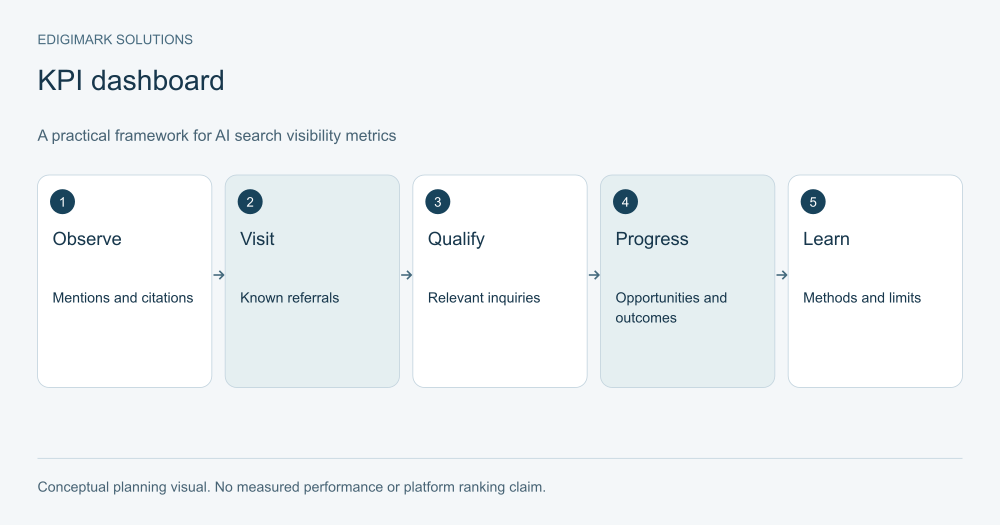
Start with whether the content is doing its job. Monitor relevant impressions and visits where available, engagement with the supporting resources, qualified inquiries and the questions sales still needs to answer. A lower volume of repetitive support questions can be useful evidence, but record how the comparison was made.
For assistant visibility, distinguish a brand mention from a linked citation and from an actual website visit. A sampled prompt result is an observation under specific conditions. It is not proof that all users see the same answer. Keep the prompt, date, service, account conditions and response available for review.
Connect the work to data analytics so the reporting reflects business outcomes. A dashboard of mentions without relevance or downstream behavior can make the program look successful while leaving commercial impact unknown.
What answer engine optimization mistakes should you avoid?
The most common editorial mistake is answering questions the business wishes customers would ask. A page about “why our revolutionary platform is best” may satisfy internal messaging, but it does not resolve a user’s compatibility or implementation concern.
Another mistake is removing all nuance to create a short answer. Readers need to know exceptions, prerequisites and uncertainty. Concision should preserve the decision, not conceal risk. Place essential qualifications next to the conclusion rather than burying them in a final disclaimer.
Do not create near-identical pages for every phrasing of the same question. Maintain one strong resource for the task and improve it as new information arrives. Also avoid presenting a plugin score or schema validation result as proof that an answer engine will use the page.
How do you turn question intent into an editorial brief?
Use a brief with six decisions: who is asking, what they want to do, what answer you can verify, what changes the answer, what evidence supports it and what the reader should do next. This prevents the writer from mistaking a topic for a task. “Pricing” is a topic; “understand which implementation requirements change the quote” is a task.
For a hypothetical workflow service, the brief might name a small operations team using two disconnected systems. Its central question is whether automation is worthwhile before the records are cleaned. The answer depends on the severity of inconsistent fields, the process being automated and the cost of propagating errors. The article should therefore explain those conditions rather than issue a universal recommendation.
Give the writer a source packet rather than a collection of search snippets. It can include approved process notes, an example field map and a short interview with the implementation owner. Ask the reviewer to check the answer’s boundaries before the editor refines the wording. If the boundaries change, the headline and opening should change with them.
Separate essential facts from optional context. A reader needs to know that duplicate records may trigger repeated messages. They may not need a history of automation platforms. Cutting optional material creates space for an actual decision table without making the article longer than its purpose requires.
What does a useful direct answer content review look like?
Review the page in three passes. First, read only the opening and headings. Can you explain what the page answers and who it helps? Second, inspect claims and examples. Can you identify their basis and limitations? Third, follow the suggested next steps as a reader. Do the links work, and do the destinations match the promise?
A reviewer should challenge sentences such as “seamless integration,” “instant results” and “works with any system.” Replace them with observable behavior: the records synchronized, the update schedule, the supported connectors or the prerequisite configuration. Precise claims are easier to maintain when the product changes.
Read a short answer beside its supporting details. If the answer says an implementation is quick but the explanation lists several unresolved approvals, revise the conclusion. The first paragraph and the evidence should agree. A qualification in the middle of a long article cannot repair a misleading opening.
Also check examples for accidental implications. A fictional scenario must be labeled hypothetical. A screenshot from a test environment must not imply a deployed customer result. A sample calculation must state its inputs. These details allow you to teach a process without pretending to possess evidence you do not have.
How should you maintain conversational search optimization content?
Create a simple inventory with the owning page, answer owner, review trigger and last substantive check. Review triggers can include product releases, changes in service scope, recurring complaints or a broken source. A calendar reminder is useful, but an event that changes the answer should prompt review sooner.
Maintain one authoritative explanation for each task. If several pages need a short version, keep their summaries consistent and link to the detailed resource. This reduces the risk that a customer sees contradictory advice on a blog, a service page and a support article.
Give sales and support a way to flag a confusing answer. Ask for the exact sentence, the customer’s interpretation and the missing condition. “This article needs work” is hard to act on; “the migration section sounds as if archived attachments are included” gives the editor a concrete correction.
Track whether an update resolved the issue. That does not require a complicated model: record the date, what changed and the feedback you receive afterward. Over time, the library becomes an operational asset grounded in customer understanding rather than a collection of articles published and forgotten.
For your first cycle, choose an answer with a responsible subject owner and accessible evidence. A narrow, accurate resource is a better foundation than an expansive page whose important claims nobody can verify.
What should your first AEO strategy review deliver?
Finish the review with a brief, an evidence packet and a named owner. The brief should make the customer question and audience unambiguous. The evidence packet should contain the facts the writer can use, including the limitations that belong near the opening answer. The owner should know which future changes require an update.
Keep the scope small enough to verify. If a proposed article needs facts from five disconnected teams, first resolve the most important uncertainty or choose a narrower task. Publishing a shorter accurate resource can create a reliable foundation for later detail. Expansion should add a new decision, evidence or example rather than repeat the same conclusion in different words.
After release, ask someone unfamiliar with the project to read the opening and find the next step. Their confusion can reveal a missing definition that the internal team no longer notices.
Frequently asked questions
Is answer engine optimization only about FAQs?
No. Definitions, comparison tables, implementation guides and service explanations can all answer useful questions. FAQs are a supporting format for specific unresolved issues; they should not replace a coherent explanation of a complex subject.
Should every heading be a question?
Use question headings where they match the reader’s task. Descriptive headings can be equally useful for a sequence, a framework or a reference table. Consistent structure matters more than forcing interrogative wording into every section.
Does AEO require special schema?
There is no universal AEO schema that guarantees inclusion in answers. Use appropriate structured data accurately when it applies, and keep visible content consistent with it. Schema cannot make an unsupported claim reliable.
Can AEO work for a small service business?
Yes, as a content method. A small company can clearly explain service scope, preparation, response processes and limitations. It should concentrate on questions it can answer well rather than trying to cover an entire industry at once.
How do we start without a large content budget?
Select a handful of recurring questions with direct business relevance. Improve existing pages first, involve the person who owns the answer and establish a maintenance schedule. Expansion should follow demonstrated usefulness, not a predetermined article quota.
Turn customer uncertainty into a useful answer
Choose one question that stalls a real buying decision. Draft the answer, identify the evidence and check the qualifications with your team. Edigimark’s digital marketing services can support the wider content and search plan. Bring your existing pages and recurring customer questions to a content planning conversation so the work begins with a concrete need.
Put the ideas to work
Explore our connected growth services →