Generative engine optimization is the work of making a business and its information easier to discover, interpret and accurately represent in generated answers. A practical GEO program combines accessible sources, useful explanations, clear identities, evidence and repeatable measurement. It supports visibility without promising that an answer engine will mention or cite a particular brand.
For a business, the useful starting question is: “What must a buyer understand before they can evaluate us correctly?” That leads to better source material than a program built around repeating the brand name or reverse-engineering individual answers.
The methods in this guide are practical recommendations informed by current primary documentation. Platform-specific details were checked in October 2026 and should be reviewed before implementation.
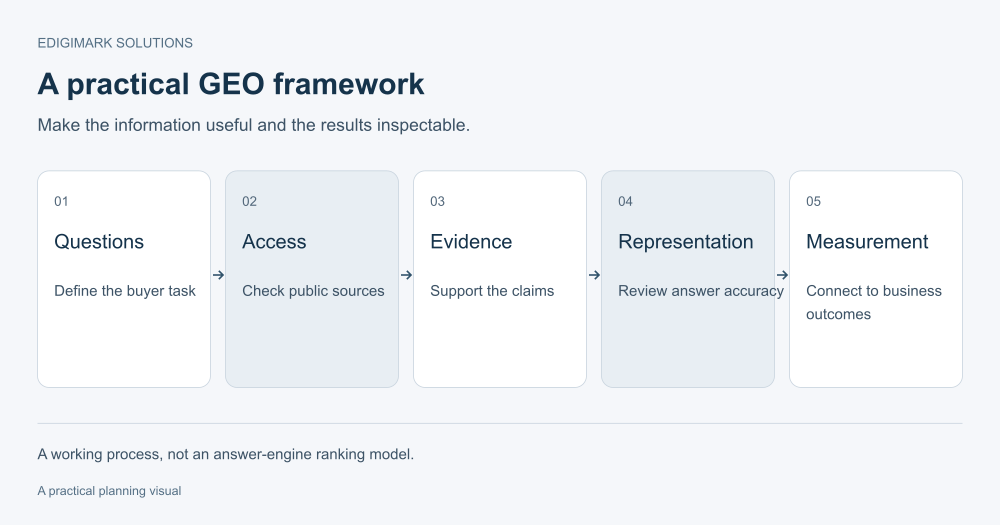
A working framework for improving information quality and evaluating discovery. It is not an answer-engine ranking model.
What does a GEO strategy include in practice?
A useful GEO scope includes five areas: access, information clarity, evidence, representation and measurement. Each should produce something the business can inspect.
Access work produces a record of whether relevant public sources can be reached. Clarity work improves explanations of the business, product or service. Evidence work develops support for claims. Representation work reviews whether sampled answers describe the business accurately. Measurement work connects observations with meaningful actions where possible.
| Area | Concrete output | Useful review question |
|---|---|---|
| Access | Public URL and crawler-access findings | Can the intended information be obtained? |
| Clarity | Revised source page or content brief | Is the subject and recommendation understandable? |
| Evidence | Documentation, methodology or verified example | What supports the claim? |
| Representation | Dated answer observations | Is the description accurate and relevant? |
| Measurement | Defined metrics and downstream reporting | What decision will the result influence? |
This scope keeps the program grounded in deliverables. A provider can explain what it changed, why the change matters and which outcomes remain outside its control.
How does generative engine optimization relate to SEO and AEO?
The areas overlap. SEO supports discoverable pages and relevant search journeys. AEO emphasizes useful answers to specific questions. GEO adds attention to representation and source use in generated responses.
Terminology varies, so define it within the engagement. Do not infer that a company needs separate implementations simply because a proposal names all three disciplines. The same accurate integration page may support each objective.
Google’s generative AI search guidance frames its AI-search work within search optimization. Other platforms have their own documentation and controls. A cross-platform program should record those differences rather than treating “AI search” as one system.
Edigimark’s digital marketing services can provide the wider acquisition context for this work. GEO should connect with the existing content, website and measurement plan.
What does generative engine optimization research establish?
The research paper GEO: Generative Engine Optimization formalizes the concept and evaluates methods within a benchmark environment. It provides a research foundation for investigating visibility, not a guarantee of results on every current commercial system.
Distinguish an experiment’s tested setting from a live marketing claim. Ask which system was evaluated, which queries and sources were used, how visibility was defined and whether the result applies to the business’s intended audience.
Avoid converting a research result into a universal promise. A provider should explain how it will evaluate the work on the actual pages and platforms in scope. A credible program can discuss uncertainty without becoming vague about its deliverables.
The practical lesson is to measure carefully and preserve evidence. That principle is useful even when the precise behavior of an answer engine cannot be inspected.
Which sources should your GEO strategy improve first?
Improve sources that answer high-value evaluation questions and that the business can maintain accurately. Start close to the commercial proposition.
A service business may need a stronger scope page. A software business may need accurate implementation and integration documentation. A professional-services firm may need an explanation of its process, limitations and evidence standards.
Take a hypothetical analytics consultancy. Its website claims to “connect marketing with revenue,” but a buyer needs to know which data sources are required, how uncertain attribution is handled and what the implementation delivers. Those are valuable content gaps.
A useful source could explain the data prerequisites, identity matching, lifecycle definitions, missing-data treatment and reporting outputs. It should also clarify what the consultancy cannot infer reliably from the available records.
This is an illustrative content-planning example. It does not describe an Edigimark client or claim that publishing such a page produces a particular visibility result.
How does a GEO strategy make entities and relationships clear?
Use specific names and explain how the named subjects relate. The organization provides a service. The service addresses a problem. The implementation connects particular systems. The evidence supports a defined claim.
Avoid using several vague labels for the same subject. If “growth analytics,” “revenue intelligence” and “marketing measurement” describe different services, explain the differences. If they describe the same offer, choose a primary name and clarify the alternatives where useful.
A reader should be able to answer basic questions after reviewing the page: Who provides the service? What does it do? What information does it require? What does the client receive? Under which conditions is it appropriate?
Relevant structured data may help express information for supported uses, but it must agree with the visible page. Do not invent reviews, credentials or relationships in markup. A machine-readable claim still needs to be true.
If the source architecture needs improvement, scope the work with website development support around the actual delivery or information problem.
What evidence makes generative engine optimization useful?
The useful evidence depends on the claim. A platform requirement needs current platform documentation. A process recommendation needs an explanation of its assumptions and trade-offs. A performance claim needs real data and a method that supports the conclusion.
Create an evidence register for important content. Record the claim, supporting source, date checked, owner and review trigger. This reduces the risk that a future update preserves an outdated statement because no one can find its basis.
Use original evidence when it is available. That might be a properly described internal analysis, a public implementation walkthrough or a genuine expert explanation. Obtain the necessary facts and permissions before treating private work as a publishable case study.
When original data is unavailable, useful synthesis is still possible. Explain a decision clearly, compare the relevant conditions and label a hypothetical scenario honestly. Avoid adding precise numbers simply to make the article look more authoritative.
How should AI search optimization test crawler access?
Use the documentation for the actual platform being evaluated. For example, OpenAI’s crawler documentation identifies OAI-SearchBot for its search features and distinguishes other crawler roles.
Inspect the intended public sources and record observed failures. The CMS API can work while the public article remains unavailable. Conversely, a public page may render correctly while metadata from the CMS never reaches the frontend.
Check each layer that the business owns: source record, delivery process, public response and relevant controls. Use a narrowly defined finding to request a narrowly defined fix.
Do not disable security controls or change participation preferences casually. Access decisions belong to the appropriate owner, and a content engagement should preserve the existing architecture unless a specific change is authorized.
Which GEO measurement methods should you use?
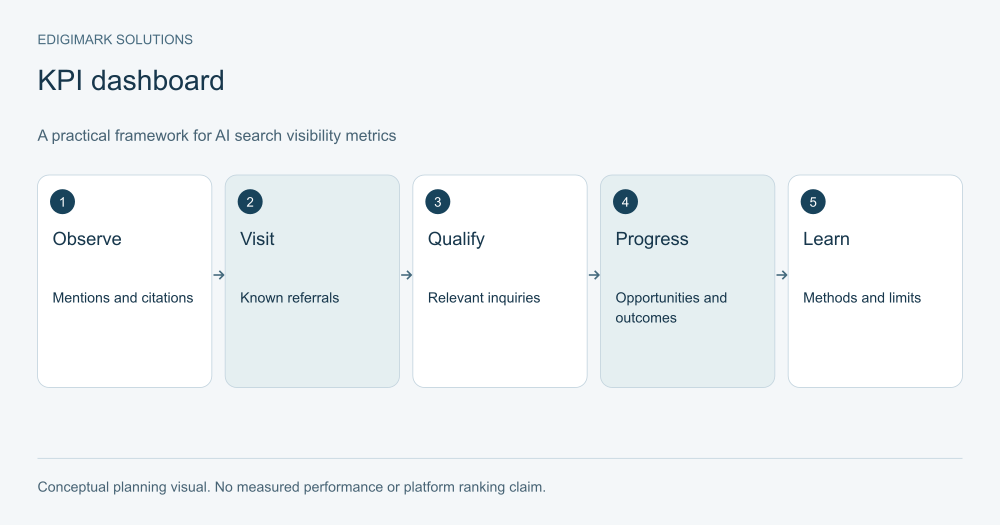
Define the unit before defining the target. A mention, citation, referral session and qualified enquiry each measure something different.
For answer observations, create a stable query set and keep branded questions separate from unbranded discovery questions. Record the platform, date and relevant context. Preserve enough of the observation to inspect accuracy later.
If you report citation frequency, define the denominator explicitly: for example, the number of eligible observations in the agreed query set. Do not present a sample percentage as the brand’s share of all AI search activity.
For Google, review the official Generative AI performance report and its current definitions. For website referrals, inspect the analytics implementation and connect the landing page with the next meaningful action.
Review enquiry quality with sales or the service owner. A visibility gain matters commercially when it reaches the right people and supports a useful decision. It may also have informational value, but that should be reported separately.
Edigimark’s data analytics services can help connect these records. CRM integration may be relevant when the business needs to follow a website action through qualification and customer stages.
What should you avoid when commissioning generative search visibility work?
Avoid a scope that promises exposure without naming the work. Ask which sources will be improved, which questions will be monitored, which access checks will be performed and which definitions will govern reporting.
Be cautious about mass publishing. Distinct keywords do not automatically establish distinct reader needs. A library of pages that repeat the same answer can become difficult to maintain and confusing for buyers.
Challenge unsupported claims about proprietary access to ranking factors or guaranteed recommendations. Ask whether a reported outcome was directly observed, estimated by a tool or inferred from another measure.
Also review the commercial next step. A well-cited article can still send visitors into an unclear service journey. Connect content with an appropriate explanation, evaluation resource or consultation. Keep the action relevant to the reader’s readiness.
What does a first GEO strategy pilot look like?
A useful pilot begins with a small set of commercially relevant questions and one or two sources that can answer them. Document the current access, clarity and representation issues.
Choose a specific improvement. That may be a better service explanation, a missing implementation condition or a source claim that needs evidence. Update the page, verify public delivery and record the change date.
Then repeat the monitoring protocol and inspect the website journey. Review what improved, what remains uncertain and what the business learned about the audience’s questions.
The pilot should produce a decision: maintain the asset, refine it, expand the coverage or redirect investment. A larger program should inherit the same evidence standards and ownership rules.
How do you turn a GEO strategy into a five-step pilot?
Start with the buyer question, check source access, strengthen the evidence, review representation and connect the observations to a commercial decision. These five steps form a working generative engine optimization process. They do not describe an answer engine’s private ranking model.
For the first step, choose a question that a suitable prospect actually needs to resolve. Write the audience, decision and expected source page into the brief. A question about implementation readiness needs different content from a request for a category definition. Keep the pilot narrow enough that the team can explain what it changed.
For the second step, inspect public access and the relevant platform’s documented controls. Record the actual page response and the available crawler evidence. Do not treat one platform’s successful request as proof of access everywhere. Resolve specific failures through the existing architecture and authorized owners.
For the third step, develop evidence that helps the reader. That may be a documented process, a transparent calculation, an accurate product walkthrough or a verified example. An original explanation should distinguish the author’s recommendation from a platform requirement. An illustrative example must remain clearly labeled rather than becoming a fabricated case study.
For the fourth step, sample the relevant answers and review how they represent the subject. GEO content optimization should improve accuracy and usefulness, not merely increase the frequency of a brand name. Save the observation protocol and inspect whether cited sources support the actual statements in the answer.
For the fifth step, review the business consequence. A citation may be useful evidence of source inclusion, but the team also needs to understand referral visits, meaningful website actions and enquiry quality. Preserve the gaps between those records. An attribution model can organize available data without proving the entire causal journey.
How should you choose a provider for GEO content optimization?
Ask for a proposed source improvement and an example of the reporting method before comparing broad visibility promises. A provider should be able to explain the page’s intended reader, its current information gap and the evidence required to address it.
Review how the provider separates platform documentation from its own working methods. Official access requirements can be verified against their source. Editorial recommendations should have a clear rationale. Claims about undisclosed ranking factors require a level of evidence that a favorable screenshot alone cannot supply.
Ask who will maintain the sources after the initial work. A GEO strategy can depend on product documentation, service pages and organizational information owned by several teams. Without a maintenance process, an improved article can become inconsistent with the actual offer. Agree on owners and review triggers rather than assuming an agency can approve every operational fact.
Compare the cost against concrete outputs. A useful scope might include a source audit, several revised briefs, a documented observation protocol and a reporting connection to qualified enquiries. The exact mix depends on the business problem. More dashboards or more articles are not automatically more valuable.
Inspect the provider’s treatment of uncertainty. It should report missing evidence and inconclusive observations without turning every change into a success story. A generative engine optimization engagement is easier to assess when the team can show what was improved, what remains unknown and which decision follows from the evidence.
Keep the pilot’s stopping conditions explicit. If source access cannot be established, resolve that prerequisite before expanding content production. If enquiries are irrelevant, revisit the audience and offer. If observations remain too inconsistent to support a decision, improve the sampling method or reconsider the investment. Assign the next action and review date to a named owner.
Frequently asked questions
Is GEO a guaranteed way to get cited by AI?
No. GEO can improve information quality, access and measurement. The platform still determines which information it retrieves and presents. A proposal should distinguish controllable work from uncertain visibility outcomes.
Does GEO require publishing new research?
Original research can be useful when it is relevant and methodologically sound, but it is not a requirement for every business. Accurate documentation, explicit conditions and useful expert interpretation can also improve a source. Never fabricate a study to fill the gap.
Can GEO work help a small service business?
It can help the business clarify its service information and evaluate discovery. Start with a small, relevant pilot and commercial questions the team can answer well. Avoid a large monitoring program before the website has useful sources and a working enquiry journey.
Should GEO reporting use a single visibility score?
A score can summarize a defined method, but the underlying observations and denominators must remain available. Use separate measures for accuracy, mentions, citations, referrals and qualified actions. Do not hide a missing measurement behind a favorable aggregate.
How do you decide whether to expand the program?
Expand when the pilot demonstrates useful learning, maintainable source improvements and a credible relationship to business goals. Set the decision criteria beforehand. To discuss a scoped pilot, contact Edigimark with the questions your buyers need answered and the sources currently intended to answer them.
Put the ideas to work
Explore our connected growth services →