To understand how to appear in ChatGPT search, begin with your public website: make important information accessible, accurate and easy to identify. Check access for OAI-SearchBot, explain what your business does and publish useful evidence around relevant buyer questions. Then track observed mentions, citations and referrals separately. These steps support discovery; they do not guarantee a recommendation.
A business can be named in an answer without its website being cited. Its website can also be cited without producing a visit or an enquiry. Decide which outcome matters before commissioning a visibility program.
The guidance here uses official crawler documentation checked in October 2026. The content and measurement recommendations are practical editorial methods, rather than claims about undisclosed ranking factors.
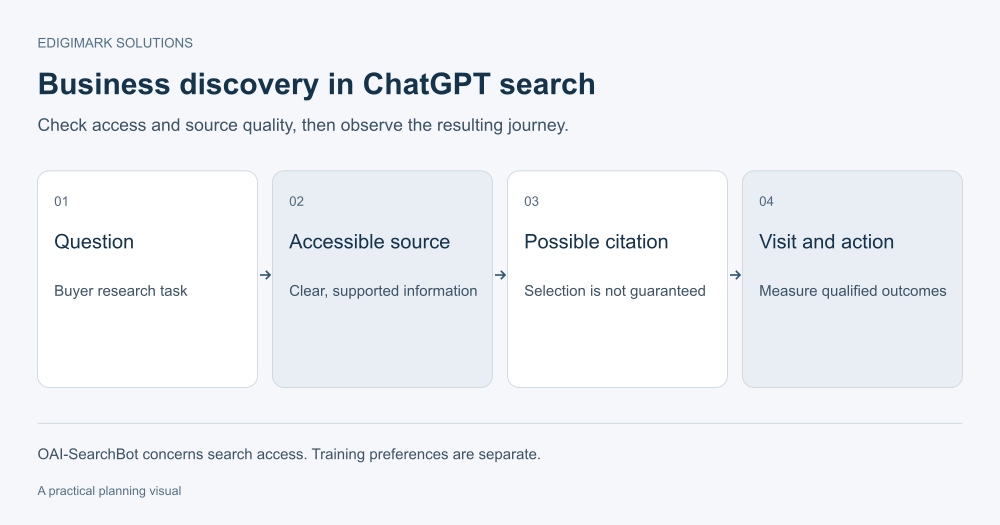
Possible discovery journey. A retrieved source is not guaranteed to be selected or cited.
What should businesses know about OAI-SearchBot?
Check OAI-SearchBot for search discovery. OpenAI’s crawler documentation distinguishes it from GPTBot, which concerns foundation-model training, and ChatGPT-User, which supports user-triggered actions.
Search and training preferences are independent. Allowing a search crawler does not require making the same choice for the training crawler. Conversely, a visit by a user-triggered agent does not prove that the search crawler can access your pages.
Inspect the controls for the public domain and important paths. For a headless website, that means the domain where customers read the article, not merely the CMS installation. Record the intended participation policy before making a change.
The same official documentation recommends permitting OAI-SearchBot and requests from its published IP ranges when search inclusion is intended. Ask the infrastructure owner to investigate any blocked requests. Keep the work scoped to that finding rather than disabling broad security controls.
How do you audit OAI-SearchBot access without guessing?
Create a small list of important public URLs: the homepage, a relevant service page, an educational article and a contact or evaluation page. Inspect the response, redirects and delivered content for each.
Look for a specific failure. Does a request receive an error? Does it receive a challenge page instead of the article? Does the page show its useful information only after a login? Does the public response contain the actual service explanation?
Do not infer crawler access from a successful visit in your own browser. A browser session may have cookies, authentication or a different network path. Use server logs and the infrastructure’s verified request information where available.
Keep a record containing URL, time, request category, observed behavior and the owner responsible for the next check. Avoid labelling the entire site “invisible to AI” based on one unsuccessful request.
If the site’s content delivery needs attention, Edigimark’s website development services provide a relevant place to discuss the specific access or rendering problem.
What information should the website make explicit?
Make the business identity and service relationships easy to understand. State the organization’s name, what it offers, whom it serves and the relevant conditions or limitations.
For a service business, useful detail includes the problem addressed, the scope of work, what the client needs to provide and how the engagement begins. An attractive page that says “we transform growth” leaves basic evaluation questions unanswered.
Keep naming consistent across the website and maintained business profiles. Explain abbreviations and product names when they first appear. If a service name changes, update the pages that refer to it and preserve a clear relationship with the previous name where necessary.
Consistency is an information-quality recommendation. It should not be sold as a guaranteed algorithmic ranking factor. The practical benefit is that buyers and systems have fewer contradictory descriptions to interpret.
Edigimark’s digital marketing service page is an example of the type of commercial source that educational content should connect to when the relationship is useful.
Which buyer questions are worth answering?
Choose questions the business can answer accurately and that help the intended audience make progress. Begin with recurring questions from sales, implementation and support.
A CRM integration provider might explain which fields need a common definition before systems are connected. A website development provider might explain the information a project team needs before planning a migration. A marketing agency might explain how it defines a qualified enquiry.
These questions create opportunities for useful, specific answers. They also expose gaps in the business’s own process. If the team cannot agree on the answer internally, resolve that issue before publishing a confident explanation.
Avoid writing a page for every possible conversational prompt. Group questions that belong to the same reader task. Keep separate pages for genuinely different decisions, such as choosing an integration approach and troubleshooting a failed synchronization.
This approach creates a content library with clear responsibilities. It also gives the sales team sources they can use during real conversations.
What does a useful source page look like?
A useful source page combines a clear answer with the evidence and conditions needed to interpret it. It should be understandable without requiring the reader to assemble fragments from several vague paragraphs.
An illustrative article about CRM integration might contain:
- A direct explanation of the integration’s purpose.
- The systems and data objects involved.
- Required fields and ownership rules.
- The normal process and important exceptions.
- A clearly labelled example.
- A checklist for evaluating the implementation.
When the subject involves a platform feature, link to current documentation. When it involves a recommendation, explain why you would choose it and when you would choose differently.
Use original materials where the business has them: accurate process diagrams, implementation notes, product documentation or a properly described study. Obtain the facts before writing a case study. Do not attach a fictional customer name or outcome to an illustrative example.
Keep source quality high even when the topic seems simple. “We support integrations” is a claim. Explaining which integration, what it transfers and what it does not transfer makes the claim useful.
How should you approach brand mentions in ChatGPT beyond your website?
Maintain accurate information in places where the business legitimately participates. Relevant professional profiles, partner directories and genuine expert contributions can help people understand the business in context.
Choose a contribution because it helps the audience. An interview explaining a real implementation trade-off is useful. A mass-produced comment repeating the brand name adds little evidence and can damage credibility.
Review the facts in any third-party description you can influence. Correct inaccurate service claims and outdated links. If the source is outside your control, record the issue and use an appropriate correction process.
There is no sound basis for promising that a particular mention will produce a ChatGPT recommendation. Treat accurate third-party representation as part of broader brand and information management.
Within the website, contextual links help readers move from the question to the relevant commercial explanation. A discussion of lifecycle handoffs may connect to marketing automation and CRM integration when those services address the problem being explained.
How do you monitor ChatGPT search visibility?
Use a small, documented query set instead of an unstructured collection of screenshots. Include category questions, problem questions and evaluation questions that suit the business. Keep direct brand questions in their own group.
For each observation, record the query, date, context, whether search was used, whether the brand appeared and which sources were cited. Save the answer or another inspectable record where permitted.
Review accuracy alongside frequency. An answer that names the business but gives it the wrong service or location is not an uncomplicated success. Record the underlying information problem and investigate available sources.
If the answer does not include the business, avoid attributing the result immediately to one missing keyword or file. It may reflect the query, available sources, context or other behavior the business cannot inspect directly.
Repeat the same protocol over time and document changes. A monitoring tool is useful when it makes that process more consistent, not merely when it provides an unexplained score.
How do you connect ChatGPT referral traffic with commercial outcomes?
Inspect analytics for visits associated with ChatGPT and other relevant discovery sources. Verify how the implementation identifies them. Preserve observed campaign parameters and referrer information when the visitor journey legitimately provides them. Test the reporting with actual visits rather than assuming every referral can be classified completely.
Track the landing page and the next meaningful action. A reader may visit an article, move to a service page and later request a consultation. Preserve the useful journey without pretending that every sale can be attributed perfectly.
Separate visits from qualified enquiries. Define an enquiry-quality check with sales: relevance, stated problem, implementation fit or another business-specific criterion. Compare similar cohorts and time periods.
Also keep unknowns visible. Some people may discover the business through an answer and return through another channel. Customer-reported discovery can add context, but it is not a complete causal measurement system.
Edigimark’s data analytics services can help connect referral observations, website actions and CRM outcomes. The right model depends on the information actually available.
What belongs in a ChatGPT search visibility sprint?
Choose one commercially relevant question and its existing source page. Verify public access, correct identity details and improve the answer. Add the evidence that the reader needs, then test the next step on the website.
Record the change date and create a repeatable monitoring query. Check analytics tagging and enquiry capture. Review whether the new source is useful to buyers even before any search visibility changes.
Expand only after the first asset teaches the team something. That could be an unresolved access problem, a buyer question the page did not address or a qualification issue after a referral visit. A useful sprint produces an observable improvement and a clear next decision.
What should a seven-check ChatGPT search visibility review cover?
Review seven connected areas: the buyer question, public access, search crawler controls, business identity, answer quality, supporting evidence and referral measurement. This is a practical checklist for evaluating how to appear in ChatGPT search; it is not a description of seven ranking factors.
Begin with the buyer question and the relevant public source. A broad request for software recommendations and a narrow integration question may need different evidence. Name the page that should help each reader, then confirm that it actually provides the required information.
Check public access and OAI-SearchBot controls separately. The page may load in your browser while relevant automated requests are blocked. Equally, a successful crawler request does not prove that the page answers the question well. Record the specific observation and the system owner who can investigate it. Keep training preferences separate from search participation.
Review identity information next. A buyer should be able to distinguish the business from similarly named organizations and understand its actual service scope. Use consistent names for products, locations and offerings. Correct inaccuracies in sources the business controls, rather than assuming a different crawler setting will resolve a naming problem.
Read the main answer without the surrounding sales language. Does it explain the conditions, requirements and limitations that affect a decision? Does each important claim have a source or a defensible explanation? Useful ChatGPT citations depend on information worth citing, even though no specific citation can be guaranteed.
Finally, inspect how visits and enquiries will be recorded. Test the landing page’s next step and preserve legitimate referral information through the journey. A ChatGPT search visibility report should distinguish an observed answer from a visit, and a visit from a suitable enquiry.
How should you respond to inaccurate brand mentions in ChatGPT?
Save the observation with the exact question, date and platform context. Separate a factual error from a recommendation the business dislikes. An answer that gives the wrong integration requirement needs a factual review. An answer that prefers a competitor may reflect a different evaluation task rather than an error.
Identify the sources shown with the answer and inspect the claims they support. If a source under your control contains outdated information, correct the source and document the change. If several pages describe the service inconsistently, clarify the source of record and update the related pages where authorized.
Do not publish a correction that overstates the opposite claim. For example, discovering that an answer incorrectly says a product lacks an integration does not justify saying that it integrates with every system. Explain the actual supported integration, its prerequisites and any limitations. Accurate specificity helps readers regardless of how quickly a sampled answer changes.
Use the platform’s available feedback mechanism when appropriate, while preserving the original observation. Submitting feedback does not establish a response time or a guaranteed correction. Recheck through the same monitoring protocol and report the observed state rather than an assumed outcome.
Review ChatGPT referral traffic separately from answer accuracy. A referral may lead to a page that resolves the misunderstanding, but analytics will not tell you every detail of the preceding conversation. Ask sales to record repeated misconceptions in enquiries. Those notes can reveal a content gap without exposing or reconstructing a customer’s private chat.
Assign a maintenance owner for important source pages. Product details, implementation conditions and commercial terms can change. A program about how to appear in ChatGPT search should include a reliable way to keep those facts current, alongside access checks and measurement. Record the next review date and the events that should trigger an earlier update.
Frequently asked questions
Does allowing GPTBot guarantee ChatGPT search visibility?
No. OpenAI distinguishes GPTBot’s training role from OAI-SearchBot’s search role. Review the search crawler controls independently and keep the publisher’s training preference separate. Access is a prerequisite to investigate, not a guarantee of selection.
Is a mention enough to count as success?
It depends on the objective. Record whether the mention is accurate, relevant and accompanied by a source. If the goal is qualified pipeline, connect observed discovery with visits and suitable enquiries where the data permits.
Should every page contain the brand name repeatedly?
No. Identify the business clearly where relevant, then answer the reader’s question. Repeating the name without additional useful information makes the page harder to read and does not establish credibility.
Can a website buy guaranteed recommendations?
A business should challenge any claim that a provider controls organic recommendations in every relevant answer. Ask for the exact product, placement, method and evidence behind the offer. Keep paid placement and observed organic discovery separately identified.
What should you bring to an Edigimark consultation?
Bring a buyer question, the public page intended to answer it and any observed access or referral issue. Talk to Edigimark about connecting that source with the service page, enquiry journey and reporting needed to evaluate it.
Put the ideas to work
Explore our connected growth services →