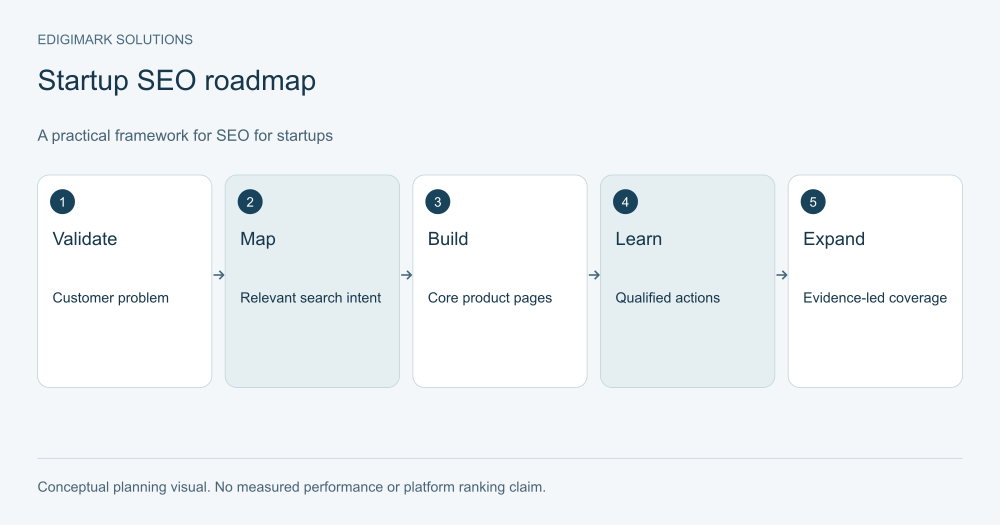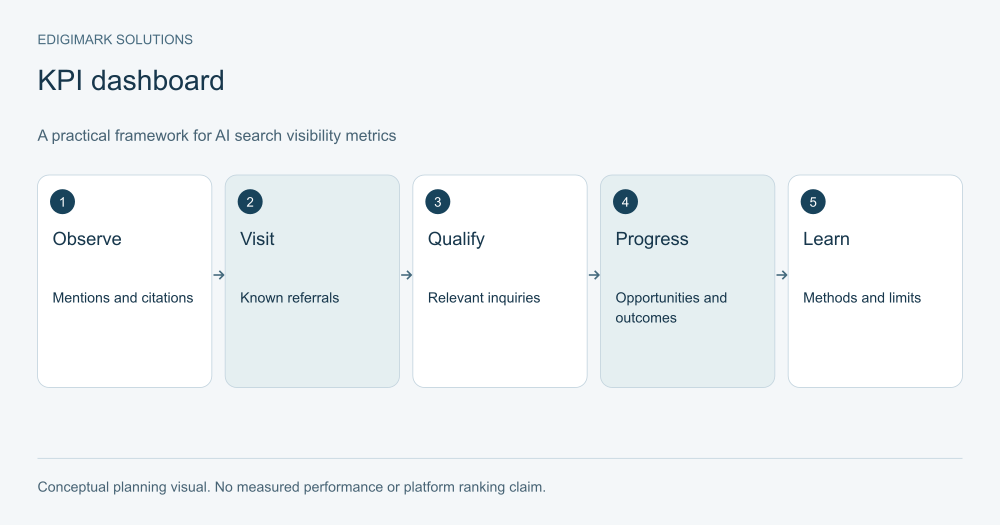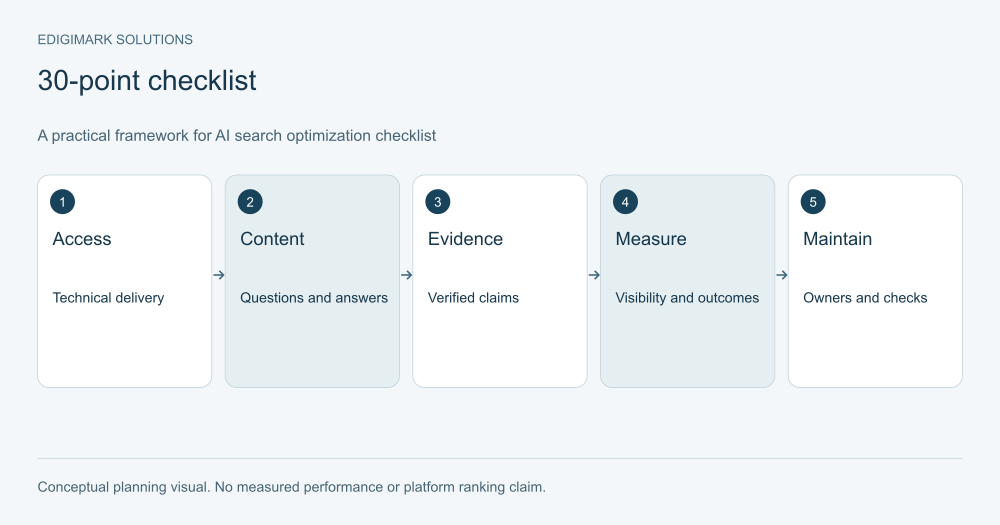
SEO vs AEO vs GEO is a comparison of overlapping priorities. SEO helps people discover useful pages through search. AEO emphasizes answering a specific question clearly. GEO focuses on discoverability and representation in generated answers. A business usually needs a coordinated search program with different checks for each surface, rather than three disconnected content programs.
The labels are useful for planning, but the terminology is not standardized across agencies and platforms. Before buying a service, agree on the work it includes and how success will be measured. A new acronym is not an implementation plan.
This is a 2027 planning guide based on information checked in October 2026. Future platform behavior should be treated as an assumption to review, not a settled fact.
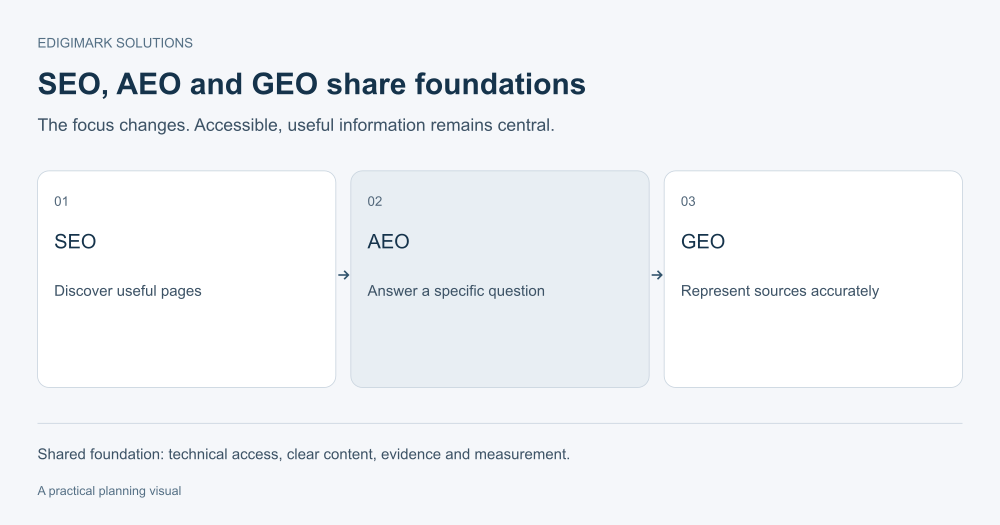
The disciplines build on shared foundations. The diagram does not imply that one replaces another.
How should you compare SEO vs AEO vs GEO?
The practical difference lies in the immediate task. SEO asks whether a relevant page can be discovered and satisfy a searcher. AEO asks whether a question receives a useful, self-contained answer. GEO asks whether generated responses can find, interpret and accurately represent the business or its information.
| Discipline | Planning question | Example work | Evidence to review |
|---|---|---|---|
| SEO | Can the right searcher find and use this page? | Crawlability, intent alignment, useful page content and internal links | Search impressions, visits and qualified actions |
| AEO | Does this content answer the question clearly? | Direct answers, definitions, conditions and useful question headings | Answer accuracy and observed answer-surface inclusion |
| GEO | How is the business represented in generated answers? | Accessible sources, explicit entities, evidence and consistency | Sampled mentions, citations, referrals and downstream outcomes |
These are working definitions for this guide. AEO and GEO overlap, particularly when an answer engine generates a response from retrieved web sources. Avoid spending time policing the labels while the website still gives buyers an unclear answer.
Is AEO or GEO replacing SEO?
For planning purposes, keep SEO as part of the shared foundation. An AI-search program still needs a website that exposes accurate, useful information to people and relevant systems.
Google explicitly frames optimization for its generative AI search features as search optimization in its current official guidance. That statement concerns Google Search. It does not establish identical behavior for every assistant or search platform.
The practical implication is to coordinate the work. Fix a broken public article before designing a citation-monitoring dashboard. Clarify what a service includes before trying to increase brand mentions. Improve a useful source once, then evaluate how it performs across different discovery surfaces.
An agency offering a GEO program should explain which platforms it will monitor, which existing SEO and content activities it depends on, and what evidence would justify continuing the investment.
How do the three approaches work on the same page?
Consider a hypothetical SaaS company that provides scheduling software for teams operating across several locations. A prospective buyer asks whether scheduling software can work with an existing payroll system.
The SEO task is to build an accurate integration page that suits that buying question and can be reached from the product navigation. A broad “best software” article may attract a different audience and fail to resolve the integration concern.
The AEO task is to answer the integration question near the beginning. State which system is supported, what the connection does, which setup conditions apply and where the reader should go for details. Do not make the reader interpret a diagram before learning whether the integration exists.
The GEO task is to make the relationship between the product, payroll system and supported workflow explicit. Use consistent names, document the limitations and substantiate the claim with a current walkthrough or product documentation.
All three tasks improve the same asset. None requires inventing a new success story, publishing dozens of wording variations or repeating an exact-match keyword in every heading.
What should you prioritize in SEO vs AEO vs GEO?
Choose the first task by the most consequential failure in the journey.
If relevant pages cannot be accessed or indexed, begin with technical diagnosis. If pages are accessible but vague, begin with editorial and service-information work. If buyers repeatedly misunderstand the business, review identity consistency and the evidence that supports its claims.
If discovery is working but enquiries are poor, review qualification and conversion. More exposure can amplify an unclear offer. Edigimark’s conversion rate optimization services can help connect page research with commercial outcomes.
A sensible assessment samples several page types: a commercial service page, an educational article, a comparison or evaluation page and the contact journey. Inspect the actual public pages, not only the CMS editor. In a headless system, a saved title or canonical is useful only if the public frontend receives the intended values.
What changes in an SEO and AI search content brief?
The brief should identify the reader’s task before listing keywords. “Write about marketing automation” is too broad. “Help a marketing operations manager decide which handoffs to automate first” is a useful assignment.
Add four fields to the brief:
- Primary question: What decision or problem does the page resolve?
- Direct answer: What can be stated accurately in the opening?
- Conditions: What changes the advice or limits its applicability?
- Evidence: Which documentation, original analysis or real experience supports the explanation?
Use supporting questions to deepen the answer. A question heading should earn its place by introducing a different issue. Five versions of “What is marketing automation?” create repetition without improving the page.
An answer can be concise while the article remains substantial. Put the core response first, then provide the method, examples, exceptions and next steps. This helps a busy reader assess whether the page is relevant before committing to the detail.
Which technical checks support SEO and AI search?
Maintain a shared access checklist and record platform-specific controls separately. The public URL, status response, canonical, visible content and internal discovery path are common concerns. Crawler controls and reporting options can differ.
For OpenAI’s search features, its crawler documentation identifies OAI-SearchBot as the search crawler. Verify access to the public content rather than assuming a successful Googlebot request establishes access for every other crawler.
For Google’s generative AI search features, check the relevant property’s Search generative AI control. A parent property can affect the setting inherited by a child property. Record the observed control and owner rather than changing it as part of an unrelated content task.
These checks should fit within the existing architecture. A content program should not casually change authentication, routing, hosting or global indexing settings to satisfy a checklist.
How do you measure SEO and AI search without double counting?
Use separate measures for separate outcomes, then connect them through the customer journey.
Search impressions indicate exposure in a search reporting system. A brand mention indicates that a sampled answer names the business. A citation indicates that an answer points to a source. A referral visit indicates that someone arrived. A qualified enquiry indicates commercial progress. These are not interchangeable units.
For sampled AI answers, document the query set, platform, date, location where relevant and number of observations. Keep branded prompts separate from unbranded discovery questions. Asking an assistant about your brand directly tells you something different from asking for a category recommendation.
Do not add mention counts to website sessions or compare a citation percentage against a conversion percentage as though they share a denominator. Keep the evidence inspectable.
Use data analytics to connect visits with meaningful actions, while keeping unattributed or uncertain outcomes visible. The objective is a clearer commercial decision, not a larger blended visibility number.
How should you fund SEO and AI search?
Allocate resources to identifiable work rather than to the acronyms themselves. Start with maintenance and content quality, then fund focused discovery and measurement experiments.
A small program may need a technically sound website, a few strong commercial pages, useful answers to recurring buyer questions and basic referral reporting. A larger business may need coordination across product documentation, editorial content, brand information and several monitored platforms.
Ask what an additional investment will produce. A credible scope names the assets to improve, technical checks to perform, sources to develop and observations to collect. It also identifies what the provider cannot control, such as whether a particular system chooses a source for a specific answer.
Edigimark’s digital marketing services can connect these activities with the wider acquisition plan. Technical gaps may also need website development support, scoped around the issue actually found.
How should you assess AEO vs GEO agency claims?
Challenge guaranteed rankings, guaranteed citations, universal “AI scores” and claims that one file or schema type unlocks visibility everywhere. Ask for the underlying evidence and the exact platform documentation supporting the recommendation.
Also ask how the agency avoids cannibalization. If several planned articles address the same audience, question and decision, unique keywords alone will not make their purpose distinct. A good map assigns different tasks to different pages and explains how they connect.
Request examples of the proposed work rather than unexplained performance promises. A revised service-page outline, a technical finding or a defined monitoring protocol is easier to evaluate than a claim of proprietary access to an answer engine’s ranking system.
What does a useful search optimization comparison include?
A useful search optimization comparison starts with the work already happening. Inventory the pages, research, technical maintenance and reporting that the business funds today. Then identify the additional tasks required by a proposed answer or generative search program. This makes overlap visible before it becomes duplicate spend.
For example, an illustrative service business may already maintain implementation guides and case studies. Those assets may support SEO and AI search if they are accessible, accurate and relevant. The new work might involve reviewing how sampled answers represent the service, correcting inconsistencies in source information and connecting referrals to enquiries. Commissioning another set of generic definitions would add less value.
Compare SEO and AI search deliverables with enough precision to assign an owner. “Improve authority” needs a concrete interpretation: interview a qualified contributor, verify a claim, document an implementation condition or improve a neglected source page. “Increase AI visibility” needs a defined observation protocol and a way to judge relevance. A dashboard alone does not explain what to change.
When comparing AEO vs GEO proposals, ask whether the difference changes an implementation decision. One proposal might emphasize extracting clear answers from existing pages. Another might emphasize evidence and brand representation across several sources. These can be complementary tasks. They do not necessarily require separate articles about the same buyer question.
Include dependencies in the comparison. An accurate answer cannot repair an inaccessible page. An accessible page cannot substantiate an unsupported claim. A growing citation count cannot establish lead quality without appropriate measurement. The sequence should reflect the largest observed constraint rather than the service label.
How should a team run an AI search visibility pilot?
Choose a small, commercially relevant question set and one group of source pages. An AI search visibility pilot should tell the business whether a specific improvement is useful, whether it can be maintained and what further evidence is required. It should not begin with a promise to dominate every answer platform.
For each question, describe the intended audience and decision. Keep evaluation questions separate from requests for a basic definition. Keep branded questions separate from unbranded discovery. Otherwise, a pilot can report favorable mentions while avoiding the actual questions a new buyer might ask.
Record a baseline before making changes. Capture the platform, question, date and observed response. Note which sources were cited and whether the answer accurately represented the business. A result that mentions the wrong service or an outdated condition needs a different response from a result that simply omits the brand.
Improve the source for a reason that also helps readers. Clarify a requirement, update a product detail, document an exception or add useful supporting evidence. The SEO vs AEO vs GEO decision becomes easier when the proposed work has a clear benefit regardless of whether one sampled answer changes.
Review the pilot with separate measures. AI search visibility observations describe sampled answers. Website analytics describe visits and actions. Sales notes describe the relevance of enquiries. None of these alone explains the entire journey. Preserve missing attribution instead of assigning it to the channel the team wants to justify.
Decide what would warrant extending the pilot. That might be a repeatable source-maintenance process, better answer accuracy or useful qualified referrals. An inconclusive pilot may still expose a reporting problem worth fixing. Record the next decision, its owner and its review date rather than treating continued activity as evidence of success.
What should an SEO and AI search decision record contain?
Keep the observation, proposed change and intended decision together. A record should be short enough to maintain and specific enough that another person can verify it.
| Field | Example of useful detail |
|---|---|
| Buyer task | Compare implementation approaches for a defined service |
| Source | The actual public page intended to resolve that task |
| Finding | A missing prerequisite, outdated detail or access failure |
| Action | A scoped correction with a responsible owner |
| Evidence | A page response, documented fact or repeatable observation |
| Review | A date and the decision the evidence will inform |
This is a recommended operating record, not a client result. It makes SEO and AI search work easier to coordinate because technical, editorial and commercial teams can inspect the same finding. When the observation is inconclusive, record that uncertainty explicitly. Continuing a project without a decision is different from confirming that its underlying assumption was correct.
Frequently asked questions
Can one article support SEO, AEO and GEO?
Yes. A relevant, accessible article can help search discovery, answer a specific question and provide evidence that generated answers may use. Define its primary reader task and evaluate each outcome separately. No single article guarantees inclusion across platforms.
Do all articles need an FAQ section?
No. Add FAQs when they resolve useful follow-up questions or conditions that the main explanation does not cover sufficiently. A short, accurate FAQ is more valuable than repetitive questions added to meet a scoring rule. Do not assume FAQ markup creates additional search exposure.
Is a brand mention the same as an AI citation?
No. A mention names the brand. A citation links or attributes information to a source. Record them separately, then inspect whether the mention or citation is accurate and relevant to the buying question.
What should a 2027 roadmap prioritize?
Prioritize accessible public pages, clear commercial information, useful evidence and measurement that can influence a decision. Review platform controls and reporting documentation as they change. Treat predictions as planning assumptions with an owner and review date.
How can a business begin without a large program?
Choose one valuable buyer question, inspect the relevant page and identify its largest access, clarity or evidence gap. Improve that asset and measure the next meaningful action. To discuss that first priority, contact Edigimark with the page and the question your buyers keep asking.
Put the ideas to work
Explore our connected growth services →